47
Misconfigurations
Identified

We start every assessment by mapping your full cloud footprint: accounts, subscriptions, projects, regions, and the resources within them. Many organizations discover services and accounts during scoping that they did not know were active. Accurate scoping ensures nothing is missed.

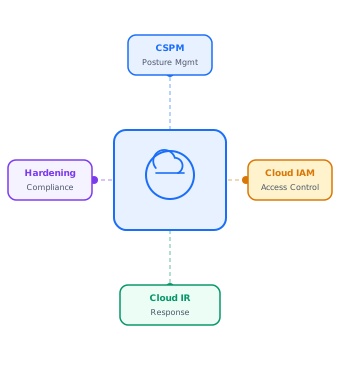
Identity and access control failures are the leading cause of cloud breaches. We enumerate all IAM principals, policies, roles, and trust relationships across your cloud environment: identifying overly permissive access, unused credentials, privilege escalation paths, and cross-account trust issues.

We assess your cloud resources against CIS Foundations Benchmarks for AWS, Azure, and GCP: covering identity, logging, monitoring, networking, storage, and compute services. Every finding is documented with its risk rating, evidence, and specific remediation steps.

We analyze your cloud network architecture for exposure risks: publicly accessible resources that should be private, overly permissive security group and firewall rules, missing network segmentation, and data exfiltration paths. Network exposure findings are correlated with IAM findings to identify the highest-risk attack chains.

We map assessment findings to your relevant compliance frameworks: SOC 2, PCI DSS, HIPAA, ISO 27001, NIST CSF, or CMMC: identifying which findings represent compliance gaps and which are security best practice recommendations. Compliance gap findings are prioritized accordingly.

The assessment delivers a prioritized remediation roadmap sequenced by risk: critical and high-severity findings requiring immediate action, medium-risk findings to be addressed within 30 to 90 days, and a longer-term security hardening plan. Every finding includes specific remediation steps, not just a description of the problem.
Our AWS environment had grown organically for three years and nobody had ever done a security review. garrisonOne found 47 misconfigurations in a single assessment: public S3 buckets, overly permissive IAM roles, unencrypted data at rest. Everything was remediated in six weeks and we passed our SOC 2 cloud controls section without a single finding.
Client results
Technology / SaaS
A seed-stage SaaS startup had customer data in a public S3 bucket. garrisonOne conducted a full AWS security assessment against CIS benchmarks and hardened the environment in 4 weeks.
Industry focus

Penetration testing prices vary enormously, from a few thousand pounds for a focused web application test to well over £50,000 for a full red …
Read More
Both penetration testing and vulnerability assessments are designed to find weaknesses in your systems. But they work very differently, and confusing …
Read More
Every business has security weaknesses. The question is whether you find them first, or an attacker does. Penetration testing (also called pen …
Read MoreRelated Services: Cloud Security | CSPM Services | Cloud Pen Testing | Security Assessment
A cloud security assessment covers identity and access management (IAM policies, roles, privilege escalation), network security (exposed resources, firewall rules, segmentation), data security (encryption at rest and in transit, public storage exposure), logging and monitoring configuration, configuration compliance against CIS benchmarks, and compliance gap analysis against relevant regulatory frameworks.
A cloud security assessment is a configuration and architecture review: evaluating how resources are configured against security best practices and benchmarks. Cloud penetration testing actively attempts to exploit misconfigurations to demonstrate their real-world impact. Assessment is faster and less disruptive; penetration testing provides higher-confidence evidence of exploitability. Many organizations do both.
A single-platform assessment (AWS, Azure, or GCP) of a mid-size environment typically takes one to two weeks. Multi-platform or complex multi-account environments take two to four weeks. The remediation roadmap is typically delivered within one week of assessment completion.
We typically use read-only access: a read-only IAM role (AWS), Reader role (Azure), or custom read-only role (GCP): scoped to the assessment boundary. We do not need and do not request write access for assessment engagements. The specific permissions required are documented in advance so your cloud team can create the access before the engagement begins.
A cloud security assessment is comprehensive for configuration and compliance but does not test for application-layer vulnerabilities in workloads running in the cloud. For a complete picture, pair the cloud security assessment with application penetration testing and cloud penetration testing that actively attempts to exploit identified misconfigurations.
At minimum annually, or after major architectural changes. Organizations with active cloud development should run quarterly assessments or implement CSPM for continuous monitoring. Compliance frameworks like SOC 2 and PCI DS