200+
Orphaned Accounts
Remediated

We work with your business and IT teams to map job functions to access requirements, identify role conflicts and segregation of duties violations, and design a role model that reflects how your organization actually works: not an idealized org chart.

Most organizations starting RBAC have years of accumulated over-privilege: previous roles, departures never deprovisioned, shared accounts no one owns. We run a structured access review and clean up the entitlement landscape before implementing new controls.

We identify SoD conflicts in your current access model and implement controls that prevent the combinations most relevant to your risk profile and compliance requirements: preventing any single user from holding conflicting permissions.

We implement RBAC across Active Directory, Microsoft Entra ID, AWS IAM, and GCP. Role assignments are managed centrally and enforced consistently whether users are accessing on-premises systems or cloud resources.

We implement automated access certification workflows: using SailPoint, Saviynt, or built-in platform capabilities: so managers review and approve access regularly without IT involvement for every case.

We deliver a complete RBAC framework document: role definitions, access matrices, SoD policy, and review procedures: that satisfies SOC 2, HIPAA, ISO 27001, and PCI DSS auditor requirements.
Understanding RBAC
What is RBAC?
Role-Based Access Control is an access management approach where permissions are assigned to roles rather than to individual users. Each user is assigned one or more roles based on their job function, and inherits the permissions defined for those roles. This replaces ad hoc, user-specific permission grants with a structured model that is consistent, auditable, and manageable at scale.
Who needs it?
RBAC is essential for any organization with more than a small team and more than a handful of systems. It becomes critical when compliance frameworks require demonstrable least-privilege access, SOC 2, HIPAA, PCI DSS, ISO 27001, and CMMC all audit whether users have only the access their role requires. It also matters operationally: without roles, onboarding and offboarding require manual access decisions for every person.
Why does it matter?
Over-privileged accounts are the most commonly exploited condition after credential theft. When an attacker compromises a standard user account that has accumulated admin-level permissions over time, they have everything they need. RBAC enforces least privilege by design, users get only what their role requires, excess permissions are removed, and access automatically reflects role changes rather than accumulating indefinitely.
How is RBAC implemented?
Implementation starts with role design, mapping your org structure to a role model that reflects actual job functions. Existing entitlements are reviewed and cleaned up, excess permissions removed. Roles are built in Active Directory, Entra ID, or your cloud directories. Segregation of Duties controls prevent policy-violating role combinations. Automated access review processes run on a schedule to catch drift before the next audit.
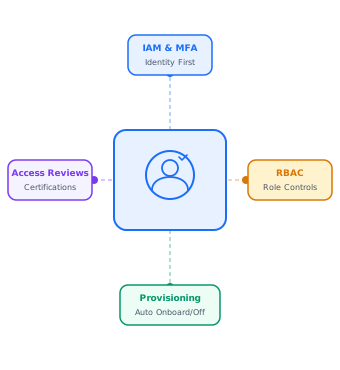
We had over 200 contractor accounts in Active Directory that nobody owned. garrisonOne mapped every identity, implemented PAM controls for privileged accounts, and set up automated provisioning and deprovisioning tied to our HR system. First audit after rollout, the finding list was empty.
Client results
Financial Services
Manual offboarding across 14 systems took two days. garrisonOne automated the full user lifecycle with HR-driven provisioning and role-based access, cutting offboarding to 10 minutes.
Healthcare
Joiner-mover-leaver delays caused access provisioning gaps and HIPAA exposure. garrisonOne automated JML workflows and implemented access certification across clinical systems.
Industry focus

Penetration testing prices vary enormously, from a few thousand pounds for a focused web application test to well over £50,000 for a full red …
Read More
Both penetration testing and vulnerability assessments are designed to find weaknesses in your systems. But they work very differently, and confusing …
Read More
Every business has security weaknesses. The question is whether you find them first, or an attacker does. Penetration testing (also called pen …
Read MoreRelated Services: IAM Services | PAM Services | Zero Trust | SailPoint IGA
RBAC is an access control model where permissions are assigned to roles, and roles are assigned to users based on job function. Users inherit the permissions of their role rather than having permissions assigned individually, making access management scalable and auditable.
RBAC assigns access based on static roles tied to job function. ABAC evaluates dynamic attributes at access time: user department, device type, time of day, data classification. RBAC is simpler to implement and audit. Most organizations use RBAC as a foundation with ABAC-style conditional access for sensitive resources.
Segregation of duties prevents any single user from having the combined access needed to complete a high-risk transaction without oversight. SoD violations are a leading cause of financial fraud and are specifically required by PCI DSS, SOX, and ISO 27001.
Access control requirements in SOC 2 (CC6.1, CC6.3), HIPAA, PCI DSS (Requirements 7 and 8), and ISO 27001 (A.9) all require documented, enforced access controls based on least privilege. RBAC is the standard implementation approach.
A focused RBAC implementation for a mid-size organization typically takes six to twelve weeks including access review, role design, implementation, and documentation.
Existing access is reviewed and right-sized. Users with more access than their role requires have excess permissions removed. Users lacking access required for their role have it added. The goal is every user with exactly the access their job requires: no more, no less.
Resources
Company
Contact


