50%
Security Spend
Reduction

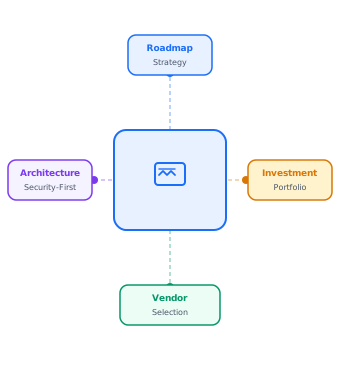
We develop IT strategies that translate your business objectives into a clear technology direction. This includes assessing your current state, identifying the technology capabilities your business needs over the next two to five years, and building a prioritized roadmap that sequences investments based on business value, risk reduction, and operational dependencies. The output is a strategy your leadership team can use to make decisions, not a document that sits on a shelf.

Technology strategy and security strategy cannot be developed in isolation. We integrate security architecture into IT planning from the outset, ensuring that new systems, platforms, and technology investments are designed with appropriate controls rather than having security bolted on after implementation. Security-first architecture planning reduces remediation costs and produces technology environments that are easier to manage, audit, and protect over time.

Technology without governance produces fragmented decisions, inconsistent security practices, and spending that lacks accountability. We design IT governance frameworks and operating models that define how technology decisions are made, who owns them, how investments are prioritized, and how performance is measured. Governance structures are designed to be practical and proportionate to your organization, not bureaucratic overhead that slows things down.

Many organizations carry technology portfolios that have grown through acquisition, organic expansion, and reactive purchasing, resulting in redundancy, unmanaged risk, and cost inefficiency. We help you evaluate your current technology portfolio, rationalize overlapping tools and platforms, and build an investment framework that ensures future spending is tied to measurable business and security outcomes.

Digital transformation programs that ignore security create the very exposure they are supposed to reduce. We provide advisory support for organizations undergoing significant technology transformation, including cloud migration, infrastructure modernization, and platform consolidation. Our role is to ensure that transformation programs move at the pace your business requires while embedding the security and compliance controls that protect what you are building.

Selecting the wrong technology platform creates years of technical debt and security risk that is expensive to unwind. We support technology selection processes including requirements definition, vendor evaluation, security assessment of prospective platforms, and commercial negotiation advisory. We help you make well-informed, defensible technology decisions rather than selecting based on marketing or familiar vendor relationships.
We had been buying security tools reactively for years with no coherent strategy. garrisonOne assessed everything we had, identified what was redundant or misconfigured, and built a three-year roadmap that consolidated our stack while improving coverage. Our security spend is now half what it was and our posture is significantly stronger.
Client results
Legal
A 90-day remediation roadmap delivered after a full security assessment. The firm met enterprise client security requirements and avoided a regulatory incident.
Industry focus

Penetration testing prices vary enormously, from a few thousand pounds for a focused web application test to well over £50,000 for a full red …
Read More
Both penetration testing and vulnerability assessments are designed to find weaknesses in your systems. But they work very differently, and confusing …
Read More
Every business has security weaknesses. The question is whether you find them first, or an attacker does. Penetration testing (also called pen …
Read MoreRelated Services: Virtual CISO Services | Security Assessment & Audit | Compliance & Certifications | All Cybersecurity Services
IT strategy is the process of defining where your organization's technology needs to go over the next several years and how to get there in a way that serves your business goals. Without it, technology decisions get made reactively, security gaps accumulate, and spending grows without clear connection to outcomes. A well-defined IT strategy gives leadership a framework for making consistent, informed decisions about technology investment, vendor relationships, and organizational capability.
The two are inseparable. Technology decisions create security obligations, and security requirements constrain and shape technology choices. An IT strategy that does not account for security produces environments that are difficult to protect and expensive to remediate. We approach IT strategy and security strategy as a single integrated discipline rather than separate workstreams that need to be reconciled after the fact.
Typical deliverables include a current-state technology assessment, a future-state architecture direction, a prioritized roadmap with sequenced initiatives and investment estimates, a technology governance framework, and an executive summary for leadership and board communication. The specific scope depends on your organization's size, complexity, and what is most useful for your decision-making process.
A focused strategy engagement for a mid-size organization typically takes six to ten weeks from kickoff through delivery of the roadmap. Larger or more complex organizations with multiple business units, legacy environments, or significant regulatory obligations may take longer. We define scope and timeline clearly at the outset so you know what to expect and can plan stakeholder involvement accordingly.
Portfolio rationalization is the process of reviewing your current set of technology tools and platforms, identifying duplication, underutilization, security risk, and cost inefficiency, and making deliberate decisions about what to keep, consolidate, retire, or replace. Most organizations that have grown quickly or through acquisition carry significant technology redundancy that increases both operating cost and security complexity. Rationalization reduces that overhead and creates a cleaner foundation for future investment.
Organizations undergoing M&A activity, rapid growth, regulatory change, or major platform migrations need a strategy that accommodates uncertainty and sets clear decision criteria for situations that cannot be fully planned in advance. We build IT strategies that are resilient to change by defining principles and decision frameworks, not just fixed plans, so your leadership can navigate unexpected developments without losing strategic direction.
Yes. Governance can be designed or improved independently of a full strategy engagement. If your organization has a clear technology direction but lacks the decision-making structures, investment prioritization process, or performance measurement framework to execute against it consistently, we can focus specifically on building the governance model your existing strategy needs to be carried out effectively.
Compliance programs depend on technology decisions made months or years in advance. If your infrastructure, cloud architecture, or application environment was not designed with compliance in mind, the cost of retrofit can be significant. A security-integrated IT strategy ensures that compliance requirements are incorporated into technology planning early, so the systems you build and the platforms you select support your compliance obligations rather than creating new ones to manage.
Resources
Company
Contact


