200+
Orphaned Accounts
Remediated

Most organizations already have zero trust components deployed: MFA, endpoint management, cloud identity. We assess your posture against NIST SP 800-207 and the CISA Zero Trust Maturity Model, identify gaps, and build a realistic roadmap.

In a zero trust model, identity replaces the network perimeter as the primary control point. We implement identity-based access policies using your existing identity provider: enforcing MFA, conditional access, and device compliance for every access request.

Zero trust requires removing implicit trust from the network. We implement micro-segmentation and network access control policies that prevent lateral movement: a compromised device in one segment cannot reach systems in another without explicit policy authorization.

Device health is a zero trust access signal. We integrate endpoint management: Microsoft Intune, Jamf, CrowdStrike: into your access policies so only compliant, managed devices can reach sensitive resources.

Zero trust is continuous verification. We configure monitoring that evaluates risk signals during active sessions and can step up authentication or revoke access when anomalous behavior is detected without waiting for the next login.

We deliver full architecture documentation covering identity flows, network segmentation maps, and policy decisions that satisfy auditors and inform future changes.
Understanding Zero Trust
What is zero trust?
Zero trust is a security model based on the principle of "never trust, always verify", no user, device, or network location is inherently trusted, regardless of whether it is inside or outside the corporate perimeter. Every access request is evaluated against identity, device health, location, and context before access is granted, and access is limited to only what is needed for the specific task. It was formalized by NIST in SP 800-207.
Who should adopt it?
Zero trust is most urgent for organizations with remote or hybrid workforces, cloud infrastructure, third-party or vendor access, or a history of lateral movement in a previous incident. It is also required or referenced by CISA guidance, DoD zero trust mandates, and is increasingly expected by cyber insurers assessing network architecture controls during policy underwriting.
Why does it matter?
Traditional perimeter-based security assumes threats come from outside. Modern attacks prove they do not, phished credentials, compromised VPN endpoints, and insider threats all start inside the perimeter. Once inside, lateral movement is unrestricted. Zero trust eliminates the assumption of trust based on network location, so a compromised account or device cannot freely reach every system it could previously access.
How is it implemented?
Zero trust is implemented across five pillars: Identity (strong authentication for every user), Devices (only managed, compliant endpoints get access), Networks (micro-segmentation removes lateral movement paths), Applications (least-privilege access per application), and Data (classification and controls on what can be accessed and by whom). Most organizations already have components in place, implementation means closing the gaps between them.
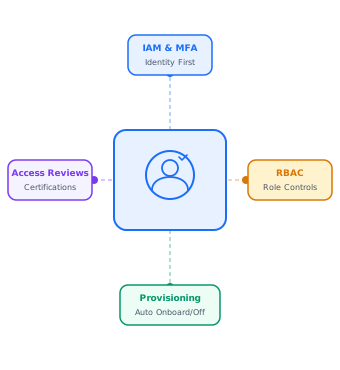
We had over 200 contractor accounts in Active Directory that nobody owned. garrisonOne mapped every identity, implemented PAM controls for privileged accounts, and set up automated provisioning and deprovisioning tied to our HR system. First audit after rollout, the finding list was empty.
Client results
Technology / SaaS
A seed-stage SaaS startup had customer data in a public S3 bucket. garrisonOne conducted a full AWS security assessment against CIS benchmarks and hardened the environment in 4 weeks.
Financial Services
Manual offboarding across 14 systems took two days. garrisonOne automated the full user lifecycle with HR-driven provisioning and role-based access, cutting offboarding to 10 minutes.
Industry focus

Penetration testing prices vary enormously, from a few thousand pounds for a focused web application test to well over £50,000 for a full red …
Read More
Both penetration testing and vulnerability assessments are designed to find weaknesses in your systems. But they work very differently, and confusing …
Read More
Every business has security weaknesses. The question is whether you find them first, or an attacker does. Penetration testing (also called pen …
Read MoreRelated Services: IAM Services | PAM Services | MFA Services | Network Security
Zero trust is a security model based on never trust, always verify. Access to resources is never granted based on network location alone. Every request is verified against identity, device health, and context, regardless of whether it originates inside or outside the traditional network perimeter.
NIST SP 800-207 defines zero trust around identity (who is requesting), device (is it managed and compliant), and network (is access limited to what is needed). Additional pillars include workload security, data protection, and visibility and analytics.
Zero trust is a maturity journey, not a one-time project. Initial foundational controls, MFA, conditional access, device management, can be deployed in four to eight weeks. Advancing through the CISA maturity model levels typically takes twelve to twenty-four months.
Not necessarily. Most organizations already have components of a zero trust architecture. Zero trust architecture unifies and extends existing tools rather than replacing them, the key is configuring them to enforce identity-based access policies.
SASE and SSE are cloud-delivered security architectures that implement zero trust principles at the network and application access layer using ZTNA, SWG, and CASB. They are one way to implement zero trust network access but not the complete zero trust program.
Zero trust is not named in most frameworks but its controls satisfy specific requirements in CMMC, FedRAMP, NIST CSF, and SOC 2. Organizations pursuing federal contracts increasingly find zero trust architecture required as a technical baseline.
Resources
Company
Contact


