200+
Orphaned Accounts
Remediated

The right SSO platform depends on your application mix, cloud footprint, and workforce structure. We assess your environment and recommend Okta, Microsoft Entra ID, Ping Identity, or cloud-native options: based on what will work in your stack.

We integrate each application into SSO: SAML 2.0, OIDC, and OAuth 2.0 configuration, attribute mapping, and federation setup. Both cloud SaaS and on-premises legacy systems can be brought into a unified SSO architecture.

Organizations working with external partners need identity federation: outside users authenticate with their own identity provider and access your systems without separate accounts. We design and implement federation policies that extend SSO securely to external parties.

SSO and MFA work together: SSO provides the single authentication point and MFA adds the second factor at that point. We integrate MFA into your SSO flow so users authenticate once with strong assurance.

Centralized SSO creates centralized visibility. We configure logging and alerting so your security team can see all authentication events, detect anomalous login patterns, and enforce session timeout policies from a single console.

SSO pairs with automated provisioning. When an employee joins, changes roles, or leaves, their access across all SSO-integrated applications updates automatically based on HR system events. No more orphaned accounts.
Understanding SSO
What is SSO?
Single Sign-On is an authentication method that allows users to log in once with a single set of credentials and access all authorized applications without logging in separately to each one. SSO is built on identity federation protocols, primarily SAML 2.0 (for enterprise applications) and OIDC/OAuth 2.0 (for modern web and mobile apps). A central Identity Provider authenticates the user; connected applications trust that authentication and grant access accordingly.
Who needs it?
SSO is the right solution for organizations managing more than a handful of SaaS applications, remote or hybrid workforces, or compliance obligations that require centralized access logging and offboarding audit trails. It is also common in B2B settings where customers or partners need federated access to your platform without managing separate credentials, a standard expectation in enterprise software sales.
Why does it matter?
Without SSO, each application manages its own credentials, creating a sprawl of weak passwords, abandoned accounts, and login events your security team cannot see. When an employee leaves, offboarding requires manually removing access from every application individually, and accounts are routinely missed. SSO centralizes authentication so access policy is enforced consistently and offboarding is immediate and complete when an account is disabled in the Identity Provider.
How does SSO work?
Implementation begins with selecting an Identity Provider (Okta, Microsoft Entra ID, Ping Identity, or similar), then integrating each application using SAML or OIDC federation. Users authenticate once to the IdP, with MFA enforced at that point, and access all integrated applications through a single session. Applications verify identity tokens from the IdP rather than managing their own login. Provisioning automation via SCIM syncs user accounts and access changes across applications automatically.
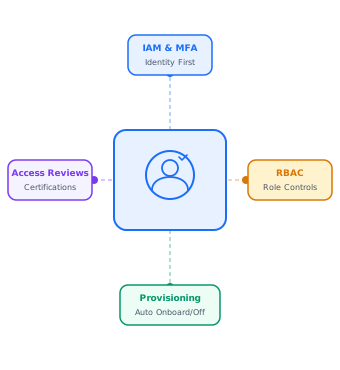
We had over 200 contractor accounts in Active Directory that nobody owned. garrisonOne mapped every identity, implemented PAM controls for privileged accounts, and set up automated provisioning and deprovisioning tied to our HR system. First audit after rollout, the finding list was empty.
Client results
Retail / SMB
A retail business with password sprawl across 20+ applications. garrisonOne deployed SSO with MFA across the full application stack in under six weeks.
Financial Services
Manual offboarding across 14 systems took two days. garrisonOne automated the full user lifecycle with HR-driven provisioning and role-based access, cutting offboarding to 10 minutes.
Industry focus

Penetration testing prices vary enormously, from a few thousand pounds for a focused web application test to well over £50,000 for a full red …
Read More
Both penetration testing and vulnerability assessments are designed to find weaknesses in your systems. But they work very differently, and confusing …
Read More
Every business has security weaknesses. The question is whether you find them first, or an attacker does. Penetration testing (also called pen …
Read MoreRelated Services: IAM Services | MFA Services | Okta Implementation | Microsoft Entra ID
Single sign-on allows users to log in once and access multiple applications without re-entering credentials. SSO uses standards like SAML 2.0 and OIDC to pass authenticated identity from a central identity provider to each connected application.
SSO reduces the number of credentials users manage, fewer passwords means less reuse and fewer phishing targets. It also centralizes authentication so security teams have a single point of visibility and control. Combined with MFA, SSO provides strong authentication across the entire application stack.
We implement Okta Workforce Identity, Microsoft Entra ID, Ping Identity, and OneLogin. For organizations already on Microsoft 365, Entra ID SSO is often the right starting point. For multi-cloud or complex SaaS stacks, Okta is frequently the stronger choice.
Yes, with the right integration approach. Applications without SAML or OIDC support can be brought into SSO using header-injection proxies, LDAP bridging, or application gateway approaches. We assess each legacy application and recommend the appropriate method.
No, SSO and MFA serve different purposes and work best together. SSO reduces separate logins; MFA ensures each login requires proof of identity beyond a password.
A focused SSO rollout for a mid-size organization covering primary SaaS applications typically takes four to eight weeks. Larger deployments with legacy integration and partner federation take two to four months.
Resources
Company
Contact


