90%
Alert Noise
Reduction

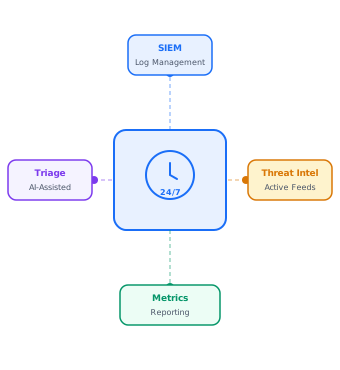
Attackers do not respect business hours, and the most damaging breaches typically begin outside them. Our analysts monitor your environment continuously across endpoints, networks, cloud infrastructure, and applications, every hour of every day including weekends and holidays. Threats are identified and escalated when they happen, not when your IT team checks their inbox the next morning.

An out-of-the-box SIEM with default rules produces thousands of alerts per day, most of them noise, and misses the subtle signals that indicate a real attack in progress. We deploy, integrate, and continuously tune your SIEM around your specific environment and the threat actors relevant to your sector. Detection rules are built on real attacker techniques and updated as the threat landscape changes, so every alert that reaches your team is worth acting on.

Every alert is reviewed, investigated, and validated before it reaches your team. We use AI-assisted triage to process high volumes of alerts at machine speed, automatically correlating related events and eliminating clear false positives so analysts can focus entirely on threats that warrant human investigation. The result is faster triage, fewer missed signals, and zero alert fatigue for your internal team.

Detection without response is just expensive logging. When a confirmed threat is identified, our analysts act immediately, isolating affected systems, blocking malicious activity, eradicating attacker presence, and guiding recovery, without waiting for your team to wake up, convene, and decide what to do. Every incident is followed by a post-incident review that closes the gap the attacker used and strengthens detection for the next attempt.

Generic threat intelligence that covers every industry and every attacker equally is not intelligence, it is noise. We enrich your detection with threat intelligence feeds specific to your sector, your technology stack, and the threat actors actively targeting organizations like yours. When a new campaign surfaces that matches your profile, we are updating detection rules proactively rather than waiting for an indicator to trigger an alert after the fact.

A managed SOC that cannot tell your leadership what it did last month, or prove that detection coverage is improving over time, is a cost center, not a security program. We deliver regular reporting at two levels: technical reports for your IT and security teams covering alert volumes, investigation outcomes, detection rule changes, and mean time to detect and respond; and executive summaries for leadership that translate SOC activity into business risk terms and show the return on the investment your board approved.
Understanding Managed SOC
What is a managed SOC?
A Security Operations Center (SOC) is a team of security analysts and the technology they use to monitor, detect, investigate, and respond to threats across an organization's environment. A managed SOC delivers this as a service, your organization gets continuous 24/7 monitoring and active incident response without hiring, training, and retaining an in-house security team. The managed SOC integrates with your existing tools and infrastructure.
Who needs it?
A managed SOC is the right solution for organizations that need continuous threat detection but cannot staff an in-house team to provide it, typically mid-market companies, healthcare organizations, financial services firms, and government contractors whose compliance requirements mandate 24/7 monitoring. It is also common after a security incident, when leadership recognizes that existing monitoring capabilities were insufficient.
Why does it matter?
The average time to detect a breach is over 200 days. During that time, attackers move laterally, establish persistence, and exfiltrate data. Continuous monitoring cuts detection time from months to hours, and the difference between a contained incident and a catastrophic breach is almost entirely determined by how fast the threat is identified and stopped. Most organizations cannot achieve this without dedicated 24/7 coverage.
How does it work?
The managed SOC ingests logs and telemetry from your endpoints, network, cloud, and applications into a SIEM, where detection rules surface suspicious activity. AI-assisted triage filters noise and correlates related events. Human analysts investigate alerts that warrant review, escalate confirmed threats, and execute containment and response. You receive regular reporting on activity, detections, and program improvements.
We had alerts coming from five different tools with no one making sense of any of it. garrisonOne consolidated everything into a single monitoring operation, cut alert noise by over 90%, and gave us a team that actually responds when something happens rather than sending an email at 9am the next morning.
Client results
Technology / SaaS
A seed-stage SaaS startup had customer data in a public S3 bucket. garrisonOne conducted a full AWS security assessment against CIS benchmarks and hardened the environment in 4 weeks.
Manufacturing
Full network penetration test and security assessment for a regional distributor ahead of cyber insurance renewal. Coverage secured at preferred rates.
Industry focus

Penetration testing prices vary enormously, from a few thousand pounds for a focused web application test to well over £50,000 for a full red …
Read More
Both penetration testing and vulnerability assessments are designed to find weaknesses in your systems. But they work very differently, and confusing …
Read More
Every business has security weaknesses. The question is whether you find them first, or an attacker does. Penetration testing (also called pen …
Read MoreRelated Services: Managed SOC | Managed IT Security | Compliance Services | IAM Services
Healthcare: Identity and monitoring built around HIPAA requirements
Read Case StudyA Security Operations Center is a team and set of processes dedicated to monitoring, detecting, and responding to security threats in real time. It acts as the nerve center of your security program, watching your environment continuously and taking action when something suspicious is identified.
An in-house SOC requires significant investment in people, technology, and processes. Hiring, training, and retaining skilled security analysts is expensive and takes time. A managed SOC gives you the same capability through a specialist provider, typically faster to deploy, more cost-effective, and with access to a broader pool of expertise than most organizations can build internally.
We work with leading SIEM platforms, EDR solutions, network monitoring tools, and threat intelligence feeds. Our approach is tool-agnostic where possible, meaning we can integrate with the security tools you already have rather than requiring you to replace your existing investments.
False positive reduction is a core part of how we operate. We tune detection rules to your environment, apply analyst judgment to every significant alert, and continuously refine logic based on what we learn. The goal is a SOC that generates meaningful alerts, not one that overwhelms your team with noise.
Our analysts investigate, confirm, and classify the threat, then execute the appropriate response actions based on agreed playbooks. This includes containment, eradication, and coordination with your team. You are notified promptly with clear information about what happened, what was done, and what you need to know.
Yes. Our SOC monitoring extends across cloud infrastructure in AWS, Azure, and GCP alongside traditional on-premise environments. Cloud environments generate their own set of logs and events that require specific detection logic, and we handle that as part of standard coverage.
Onboarding typically takes two to four weeks depending on your environment size and complexity. This covers integration with your log sources, SIEM configuration, detection rule development, and analyst familiarization with your environment. We move as quickly as your infrastructure allows.
You receive regular reports covering alert volumes and trends, confirmed incidents, investigation summaries, detection coverage metrics, and recommendations for improving your security posture. Frequency and format are agreed as part of the service setup to match your reporting preferences.
Resources
Company
Contact


