94%
False Positive
Rate Reduction

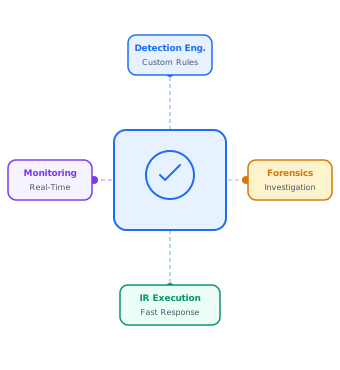
You cannot detect what you are not logging. We evaluate your existing monitoring capabilities, identify logging gaps and blind spots across your environment, and build a clear picture of where your detection coverage is strong and where attackers could currently operate without being seen.

We integrate your SIEM and develop detection rules built around realistic attack scenarios, not generic templates. Use-case driven detection strategies ensure your alerts are tied to actual attacker techniques, so your security team spends time investigating real threats rather than chasing false alarms.

We provide continuous monitoring of events and anomalies across your systems with correlation of signals from multiple sources. Rather than watching individual logs in isolation, we look for patterns that indicate attacker behavior so threats are surfaced before they cause significant damage.

When a threat is confirmed, speed and precision matter. We execute rapid containment and eradication to stop the attack and limit damage, followed by thorough root cause analysis and impact assessment to understand exactly what happened, what was accessed, and what needs to change.

After an incident, understanding what actually happened is critical to preventing a recurrence. We perform timeline reconstruction, evidence analysis, and attack vector identification to give you a complete and defensible account of the incident that supports both internal decisions and external obligations.

Attackers change their techniques. Your detection logic needs to change with them. We update detection rules based on emerging threats, integrate relevant threat intelligence feeds, and run regular reviews to ensure your monitoring capabilities stay ahead of the threats that are most relevant to your industry and environment.

AI-driven attacks operate differently from human-directed ones. They move at machine speed, adapt in real time, and produce activity patterns that static rules were not designed to catch. We deploy machine learning models trained on your environment's specific baseline to identify threats that behave like normal activity until the moment they don't, including autonomous agent intrusions, AI-assisted credential abuse, and adaptive malware that modifies its behavior to evade conventional endpoint tools.
We had a SIEM deployed but no one tuning it or reviewing alerts. garrisonOne took over detection engineering, eliminated the false-positive noise burning out our IT team, and built playbooks for alert types that actually mattered. The first week they were live, they caught a credential stuffing attack we would have missed entirely.
Client results
Technology / SaaS
A seed-stage SaaS startup had customer data in a public S3 bucket. garrisonOne conducted a full AWS security assessment against CIS benchmarks and hardened the environment in 4 weeks.
Manufacturing
Full network penetration test and security assessment for a regional distributor ahead of cyber insurance renewal. Coverage secured at preferred rates.
Industry focus

Penetration testing prices vary enormously, from a few thousand pounds for a focused web application test to well over £50,000 for a full red …
Read More
Both penetration testing and vulnerability assessments are designed to find weaknesses in your systems. But they work very differently, and confusing …
Read More
Every business has security weaknesses. The question is whether you find them first, or an attacker does. Penetration testing (also called pen …
Read MoreRelated Services: SOC Services | AI Security Services | Endpoint Security | All Cybersecurity Services
Technology: AWS environment brought under 24/7 detection and monitoring
Read Case StudySMB: Threat exposure assessed with prioritised detection and response gaps closed
Read Case StudyThreat detection and response is the combination of monitoring, analysis, and action used to identify malicious activity in your environment and stop it before it causes significant damage. It covers the tools, processes, and expertise needed to surface threats early, investigate them accurately, and contain them quickly.
A SIEM, or Security Information and Event Management system, collects and correlates log data from across your environment to identify patterns that indicate a security threat. A well-configured SIEM is one of the most important tools for detecting threats that span multiple systems. A poorly configured one generates so many alerts that it becomes a distraction rather than a defense.
We build detection use cases around known attacker techniques aligned to frameworks like MITRE ATT&CK. Each rule is tied to a realistic attack scenario, tuned to your environment, and validated to confirm it fires under the right conditions. We also test for false positives to make sure your team is not overwhelmed with noise.
Response time depends on your engagement model and the nature of the incident. For organizations with an active monitoring relationship, we can begin containment actions rapidly upon confirmation of a threat. For incident response engagements, we mobilize immediately and work with your team to stop the attack and limit damage.
We reconstruct the timeline of the attack, identify how the attacker gained access and what they did inside your environment, determine what data or systems were affected, and produce a documented account of events. This supports both internal decision-making and any legal, regulatory, or insurance obligations that follow an incident.
Threat intelligence is information about the tactics, techniques, and targets of active threat actors. We integrate relevant intelligence feeds into your detection logic so your monitoring is informed by what attackers are actually doing in the wild, not just what they have done historically. This is especially valuable for industries that are actively targeted.
No. Many of our clients do not have a dedicated security operations center. We work with organizations at different levels of maturity to build detection capabilities that are appropriately scaled to their environment, team size, and risk profile. You do not need to be a large enterprise to benefit from proper threat detection.
Every incident, near-miss, and threat intelligence update is an opportunity to improve. We run regular reviews of detection rules, update logic based on emerging attacker techniques, and incorporate lessons learned from investigations. Detection should get sharper over time, not stay static from the day it was first deployed.
Resources
Company
Contact


