0
Lateral Movement
Paths Remaining

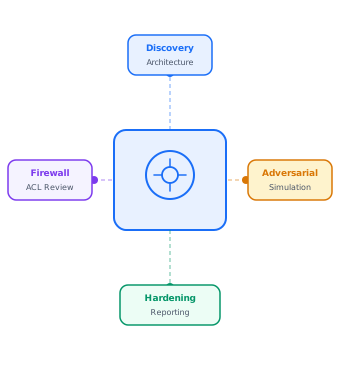
We map your full network topology, security zones, and trust boundaries to understand how your environment is actually structured versus how it was designed to be. This reveals exposed services, unintended entry points, and architecture gaps that create risk.

Firewall rules accumulate over time and often contain outdated, overly permissive, or conflicting entries. We perform a thorough review of your firewall policies, VPN configurations, and remote access controls to identify what needs tightening and what can be safely removed.

We identify weak protocols, insecure services, and misconfigurations that create lateral movement opportunities across your network. This includes everything from unencrypted management interfaces to unnecessarily open internal routes between network segments.

We run controlled internal and external attack simulations to test how far an attacker could actually move inside your network. This includes pivoting across segments and privilege escalation testing to demonstrate the real impact of a successful initial compromise.

We configure and tune your IDS and IPS systems to detect real threats rather than generating noise that your team learns to ignore. Traffic analysis and anomaly detection are set up to surface meaningful signals and give your security team actionable alerts.

We deliver risk-based remediation recommendations and a long-term network security architecture roadmap. Every recommendation is prioritized based on the actual threat it addresses, with clear steps your team can follow to implement improvements without disrupting operations.
Our network had grown organically over eight years with no real segmentation. garrisonOne mapped our traffic flows, identified critical flat-network risks, and redesigned our segmentation. The follow-up pen test confirmed attackers could no longer move laterally from a compromised workstation to our core systems.
Client results
Manufacturing
Full network penetration test and security assessment for a regional distributor ahead of cyber insurance renewal. Coverage secured at preferred rates.
Technology / SaaS
A seed-stage SaaS startup had customer data in a public S3 bucket. garrisonOne conducted a full AWS security assessment against CIS benchmarks and hardened the environment in 4 weeks.
Industry focus

Penetration testing prices vary enormously, from a few thousand pounds for a focused web application test to well over £50,000 for a full red …
Read More
Both penetration testing and vulnerability assessments are designed to find weaknesses in your systems. But they work very differently, and confusing …
Read More
Every business has security weaknesses. The question is whether you find them first, or an attacker does. Penetration testing (also called pen …
Read MoreRelated Services: Endpoint Security | Threat Detection & Response | Penetration Testing | All Cybersecurity Services
Distribution: Segmentation gaps, access controls, and firewall issues identified
Read Case StudyLegal: Network assessment with prioritised remediation roadmap
Read Case StudyNetwork security covers the controls, configurations, and monitoring that protect your infrastructure from unauthorized access, lateral movement, and exploitation. It includes your firewall rules, network segmentation, access controls, intrusion detection systems, VPN configurations, and the protocols and services running across your environment.
Segmentation limits how far an attacker can move after gaining initial access. Without it, a compromised endpoint can become a launchpad to reach critical servers, databases, and other systems. Good segmentation means a breach in one area stays contained rather than spreading across your entire network.
At least annually, and after any major infrastructure change. Firewall rule sets tend to grow over time and rarely shrink. Old rules stay in place long after they are needed, creating unnecessary exposure. A regular review removes the accumulation of outdated access and tightens your perimeter without disrupting legitimate traffic.
An intrusion detection system monitors traffic and alerts on suspicious activity. An intrusion prevention system does the same but can also block or drop malicious traffic automatically. Both require proper configuration and tuning to be effective. Out-of-the-box deployments are rarely optimized for your specific environment and traffic patterns.
We simulate how an attacker with initial access to your network would attempt to move laterally to reach higher-value systems. This includes testing segmentation controls, privilege escalation paths, and the visibility your monitoring tools have into internal traffic. The goal is to show you what a real attacker could reach and how fast.
Yes. Cloud environments have their own network constructs including virtual private clouds, security groups, and network access control lists that require the same level of scrutiny as traditional infrastructure. Misconfigurations in cloud networking are extremely common and often go undetected for extended periods.
You receive a detailed assessment report with all findings, their risk level, and specific remediation steps. We also provide a network hardening roadmap that prioritizes improvements based on the actual threats they address, giving your team a clear sequence to follow rather than a generic list of recommendations.
Yes. Remote access is one of the highest-risk areas of network security, particularly for organizations that expanded it rapidly during a shift to remote work. We review your VPN configurations, authentication controls, and split-tunneling policies to close the gaps that attackers commonly exploit in remote access infrastructure.
Resources
Company
Contact


