3
Prompt Injection
Vectors Found

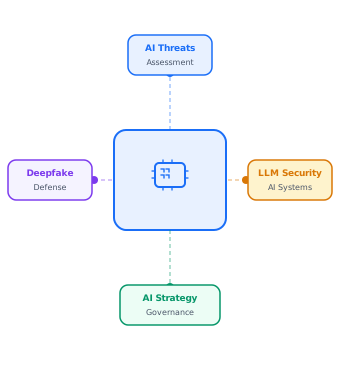
Before you can defend against AI-powered attacks, you need to understand which ones are most likely to target your organization and where your current defenses fall short against them. We assess your exposure to AI-driven attack techniques across your people, processes, and technology, identifying where an AI-powered attacker would have the highest probability of success against your specific environment and business context.

We simulate the AI-driven attack techniques that are actively being used against organizations today. This includes autonomous agent-based intrusion testing that replicates how AI attack tools conduct multi-stage reconnaissance, lateral movement, and privilege escalation without human operators directing each step. We test whether your security controls, detection rules, and response processes can identify and contain an AI-directed attack before it reaches its objective.

We deploy machine learning-driven detection capabilities that identify threats based on behavioral patterns rather than known signatures. Behavioral anomaly detection trained on your specific environment catches attacker activity that rule-based systems miss entirely, including slow-and-low intrusions, credential abuse that looks like normal user behavior, and novel attack techniques that have no signature to match. When a threat is detected, AI-accelerated investigation compresses response timelines from hours to minutes.

AI-generated audio and video are now convincing enough to impersonate executives in real-time calls. AI-crafted phishing emails are personalized using scraped data and read nothing like the obvious scam messages of a few years ago. We help organizations implement technical and procedural controls that reduce the effectiveness of AI-driven social engineering, including verification protocols for high-risk transactions, deepfake detection capabilities, and awareness training built around what AI-generated attacks actually look and sound like today.

Organizations deploying large language models, AI assistants, and AI-integrated business applications are introducing a category of risk that most security programs have not yet addressed. We assess the security of AI systems your organization uses and builds, covering prompt injection vulnerabilities, data leakage through AI interfaces, model poisoning risks, insecure AI integrations, and the access control gaps that emerge when AI tools are given broad permissions without appropriate governance. We help you deploy AI tools without creating the attack surface that comes with doing it without security oversight.

AI security is not purely a technical problem. Organizations need policies that govern how AI tools are approved, deployed, and monitored. They need governance frameworks that define who owns AI risk, how AI vendor relationships are assessed, and how AI-related incidents are identified and escalated. We develop AI security strategies and governance frameworks that give your leadership structured oversight of AI risk rather than leaving it unmanaged as AI adoption across your business accelerates.
We deployed an internal LLM for contract review and assumed the security team had reviewed it. garrisonOne found three prompt injection vectors that could have exposed confidential client data. Their AI security team also helped us build guardrails we did not know we needed. Eye-opening work.
Client results
Technology / SaaS
A seed-stage SaaS startup had customer data in a public S3 bucket. garrisonOne conducted a full AWS security assessment against CIS benchmarks and hardened the environment in 4 weeks.
Manufacturing
Full network penetration test and security assessment for a regional distributor ahead of cyber insurance renewal. Coverage secured at preferred rates.
Industry focus

Penetration testing prices vary enormously, from a few thousand pounds for a focused web application test to well over £50,000 for a full red …
Read More
Both penetration testing and vulnerability assessments are designed to find weaknesses in your systems. But they work very differently, and confusing …
Read More
Every business has security weaknesses. The question is whether you find them first, or an attacker does. Penetration testing (also called pen …
Read MoreRelated Services: Penetration Testing | Threat Detection & Response | SOC Services | All Cybersecurity Services
Technology: AWS environment secured and brought under continuous monitoring
Read Case StudySMB: Risk-based assessment and remediation roadmap delivered
Read Case StudyAn AI agent attack uses autonomous software driven by artificial intelligence to conduct cyberattacks with minimal or no human involvement at each step. Rather than a human attacker manually directing reconnaissance, privilege escalation, and lateral movement, an AI agent executes these steps automatically, adapting its approach based on what it encounters. This makes attacks faster, harder to detect through behavioral patterns tied to human timing, and capable of operating at a scale no human-directed campaign could match.
Traditional attacks follow patterns that security tools have learned to recognize over time. AI-powered attacks adapt in real time to avoid those patterns. AI-generated phishing emails use personalized content that bypasses spam filters and looks nothing like template-based scams. AI-driven malware modifies its behavior and code structure to evade endpoint detection. AI-assisted intrusions probe defenses continuously and adjust tactics the moment a technique stops working, compressing the time from initial access to impact in ways that overwhelm conventional response processes.
AI-generated phishing emails are significantly harder to detect than traditional phishing because they are grammatically correct, contextually relevant, and often personalized using data scraped from public sources. Traditional email security filters that rely on pattern matching and known indicators are not effective against them. Detection requires a combination of sender authentication controls, behavioral analysis of email traffic patterns, user verification processes for high-risk requests, and awareness training focused on what AI-generated attacks actually look like rather than the obvious scam messages of the past.
Prompt injection is an attack against AI systems, particularly large language models, where an attacker crafts input designed to override the AI's instructions and make it take actions it was not authorized to take. In a business context, this could mean an attacker using a customer-facing AI chatbot to extract internal data, bypass access controls, or perform actions on connected systems. As organizations integrate AI tools with data sources and business processes, prompt injection becomes a real attack surface that requires specific security assessment and control.
We use machine learning models for behavioral anomaly detection, training them on your specific environment's activity patterns so that deviations from normal stand out clearly rather than being lost in static rule-based noise. AI-assisted alert triage reduces the time analysts spend on false positives, keeping focus on genuine threats. AI-accelerated incident investigation compresses the time from alert to understanding what happened. Predictive threat intelligence uses AI to correlate threat actor activity patterns and identify likely next targets and techniques before they are deployed against you.
Most existing security tools were designed around the threat patterns of five to ten years ago. Signature-based detection, static rules, and human-paced response processes struggle against AI-powered attacks that adapt in real time and operate faster than conventional detection cycles. An AI threat assessment will identify specific gaps in your current stack against modern AI-driven attack techniques and give you a prioritized picture of where investment in AI-enhanced detection capabilities will have the most impact.
Deepfake attacks in business settings typically target high-value financial and access decisions. A common scenario involves an attacker generating a convincing audio or video clip impersonating a CEO, CFO, or IT leader and using it to authorize a wire transfer, request credential resets, or approve access to sensitive systems. These attacks have caused significant financial losses at organizations that relied on voice or video recognition as part of their verification process. Effective defense requires procedural controls that do not depend solely on recognizing a voice or face, combined with technical detection capabilities where feasible.
AI governance starts with visibility into what AI tools are actually being used across your organization, including shadow AI adopted by individual teams without formal approval. From there, a governance framework defines the approval process for AI tool adoption, the security assessment required before deployment, the access and data permissions AI tools are granted, the monitoring in place during operation, and the process for identifying and responding to AI-related security incidents. We build AI governance frameworks that are proportionate to your organization's AI footprint and risk profile, not over-engineered programs that create friction without corresponding protection.
Resources
Company
Contact


