100%
Endpoint Coverage
Achieved

You cannot protect what you cannot see. We identify all endpoints in your environment, including unmanaged and shadow devices that often go undetected, and classify each one based on its risk exposure, network access, and business criticality.

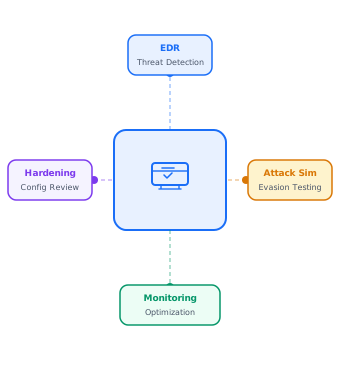
We validate your operating systems and applications against security hardening baselines, identifying gaps in your patch lifecycle, insecure default configurations, and unnecessary services that expand your attack surface without adding any business value.

We deploy and tune Endpoint Detection and Response solutions to provide behavioral monitoring and anomaly detection across your device fleet. Properly configured EDR does not just alert on known threats, it identifies suspicious behavior patterns that indicate something is wrong before damage is done.

We test your endpoint defenses against real attack techniques, including methods attackers use to bypass security tools. This includes detection bypass testing and persistence evaluation to confirm that your controls would actually catch a skilled attacker, not just commodity malware.

When an endpoint is compromised, how fast you respond determines how much damage is done. We develop endpoint containment and isolation strategies and build response playbooks so your team knows exactly what to do when a threat is detected, without having to figure it out under pressure.

Security controls degrade over time as environments change and attackers adapt. We provide real-time monitoring, alerting, and ongoing tuning of your endpoint security stack to maintain detection quality and keep pace with evolving threats across your device fleet.
After a laptop was compromised through a phishing link, we knew our endpoint setup was not adequate. garrisonOne hardened our fleet, deployed EDR across every device, and configured alerting that actually surfaces real threats. We have not had a successful endpoint compromise in the eighteen months since.
Client results
Technology / SaaS
A seed-stage SaaS startup had customer data in a public S3 bucket. garrisonOne conducted a full AWS security assessment against CIS benchmarks and hardened the environment in 4 weeks.
Manufacturing
Full network penetration test and security assessment for a regional distributor ahead of cyber insurance renewal. Coverage secured at preferred rates.
Industry focus

Penetration testing prices vary enormously, from a few thousand pounds for a focused web application test to well over £50,000 for a full red …
Read More
Both penetration testing and vulnerability assessments are designed to find weaknesses in your systems. But they work very differently, and confusing …
Read More
Every business has security weaknesses. The question is whether you find them first, or an attacker does. Penetration testing (also called pen …
Read MoreRelated Services: Network Security | Threat Detection & Response | AI Security Services | All Cybersecurity Services
Technology: Endpoints and cloud workloads brought under continuous protection
Read Case StudySMB: Endpoint and access controls assessed with a remediation roadmap
Read Case StudyEndpoint security is the practice of protecting devices that connect to your network, including laptops, desktops, servers, and mobile devices, from being compromised or used as an entry point into your broader environment. It covers hardening, monitoring, detection, and response across your entire device fleet.
Endpoints are where your users work, which means they interact with email, web browsers, and external files every day. They are also often inconsistently configured and patched. Attackers target endpoints because a single compromised device can serve as a gateway into the rest of your network.
Traditional antivirus relies on known malware signatures to detect threats. EDR, or Endpoint Detection and Response, monitors behavior continuously and can identify suspicious activity even from unknown or fileless threats. It also records detailed telemetry that makes it possible to investigate and respond to incidents effectively.
Hardening means reducing the attack surface of a device by disabling unnecessary services, applying security configurations, ensuring patches are current, and removing software that is not needed. We validate your endpoints against security baselines and help your team implement improvements systematically.
Yes. Unmanaged and bring-your-own devices are a real risk in most organizations. We help you identify these devices, assess their risk level, and determine the right approach to either bring them under management or segment them from critical systems.
We run attack simulations using real techniques, including methods attackers use to evade security tools. This validates that your EDR and other controls would detect a skilled attacker, not just known malware. We document what was detected, what was missed, and what needs to be tuned.
The first steps are isolation, investigation, and containment. How quickly and correctly your team executes those steps determines how far the damage spreads. We develop response playbooks specific to your environment so your team is prepared to act decisively when it matters most.
Yes. Remote and hybrid environments expand the endpoint attack surface significantly, with devices operating outside traditional network perimeters. Our endpoint security approach covers remote workers and ensures that security controls and monitoring extend to every device regardless of where it connects from.
Resources
Company
Contact


