200+
Orphaned Accounts
Remediated

You cannot protect what you do not know exists. We start every PAM engagement with a full discovery of privileged accounts across on-premises infrastructure, cloud environments, and third-party systems: including service accounts, shared credentials, and local admin accounts that often go unmanaged.

Every privileged credential is stored in a secure vault with time-limited checkout, just-in-time access, and full session recording. Administrators never see raw passwords. Every privileged session is recorded and can be replayed for audit or incident investigation.

Persistent privileged access is the problem PAM solves. We implement just-in-time provisioning so elevated access is granted only when needed and automatically revoked. Combined with least-privilege policies, this eliminates the standing access that attackers exploit after credential theft.

All privileged sessions are monitored in real time. Anomalous behaviors: off-hours access, unusual commands, bulk data access: trigger alerts for your security team. Full audit trails satisfy compliance requirements for SOC 2, HIPAA, PCI DSS, and ISO 27001.

We integrate PAM controls with your existing identity infrastructure: Active Directory, Azure AD/Entra ID, Okta, and SailPoint. Privileged access governance becomes part of your broader IAM program, not a separate silo.

Organizations without a PAM program need a structured approach before jumping to tooling. We assess your current privileged access landscape, identify the highest-risk gaps, and build a phased roadmap that delivers measurable risk reduction from day one.
Understanding PAM
What is PAM?
Privileged Access Management is the set of controls and processes that govern how privileged accounts, administrator accounts, service accounts, root credentials, and shared admin logins, are secured, monitored, and used. A PAM program typically includes credential vaulting, just-in-time access provisioning, session recording, and real-time monitoring of every privileged action taken in the environment.
Who needs it?
Any organization with IT administrators, cloud infrastructure, or third-party vendors who have privileged access to systems needs PAM. It is specifically required or strongly expected by SOC 2, HIPAA, PCI DSS, ISO 27001, and CMMC, all of which audit how privileged credentials are managed, monitored, and reviewed. Cyber insurance carriers have also begun requiring evidence of PAM controls at renewal.
Why does it matter?
Privileged account compromise is the most common path from initial access to full network control. Once an attacker has an admin credential, through phishing, lateral movement, or credential stuffing, they can access everything that account can reach. Most major ransomware deployments use stolen privileged credentials to spread across the network before encrypting systems. PAM directly limits what a compromised credential can do.
How does a PAM program work?
PAM starts with discovery, finding every privileged account, including the ones nobody knew existed. Credentials are moved into a secure vault, access is provisioned just-in-time and revoked automatically, and every session is recorded for audit and investigation. Behavioral monitoring alerts on anomalous actions in real time. Integration with your broader IAM stack ensures privileged access governance is part of your identity program, not a separate silo.
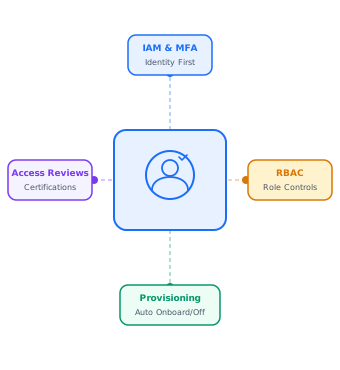
We had over 200 contractor accounts in Active Directory that nobody owned. garrisonOne mapped every identity, implemented PAM controls for privileged accounts, and set up automated provisioning and deprovisioning tied to our HR system. First audit after rollout, the finding list was empty.
Client results
Healthcare
200+ orphaned accounts remediated, zero audit findings after rollout, and full privileged access brought under governance across a multi-site medical practice.
Financial Services
Manual offboarding across 14 systems took two days. garrisonOne automated the full user lifecycle with HR-driven provisioning and role-based access, cutting offboarding to 10 minutes.
Industry focus

Every business has security weaknesses. The question is whether you find them first — or an attacker does. Penetration testing (also called pen …
Read MoreRelated Services: IAM Services | SSO Services | Zero Trust | MFA Services
Privileged access management controls, monitors, and audits access by accounts with elevated permissions, domain admins, root accounts, service accounts, and similar. PAM programs include credential vaulting, just-in-time access provisioning, session recording, and continuous monitoring of all privileged activity.
Privileged access controls are required by PCI DSS (Requirement 7 and 8), HIPAA (Access Controls), SOC 2 (CC6.1 and CC6.3), and ISO 27001 (A.9). Auditors look specifically at how privileged accounts are governed. Without PAM controls, organizations routinely receive findings that delay certifications.
We implement CyberArk, BeyondTrust, Delinea, Microsoft Entra ID PIM, and AWS IAM for cloud privileged access. We recommend the right platform based on your environment size, cloud footprint, and compliance requirements.
A foundational PAM deployment covering discovery, vaulting, and JIT access for the highest-risk accounts typically takes four to eight weeks. Full enterprise rollouts with integrations take three to six months.
Just-in-time access means privileged permissions are granted on demand for a specific task and automatically revoked when the task is complete. This eliminates standing privilege, the condition attackers exploit most often after stealing credentials.
PAM removes persistent privileged access, records all privileged sessions, and alerts on anomalous activity. Even a malicious insider cannot abuse access they do not hold. Session recordings also provide forensic evidence for investigations.
Resources
Company
Contact


