3
Critical Vulnerabilities
Identified

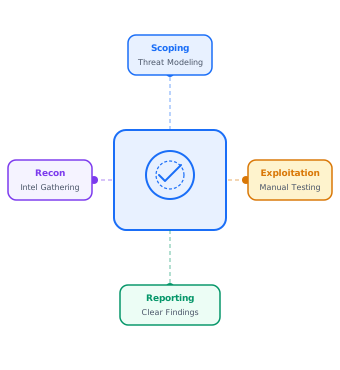
A penetration test scoped too broadly wastes time on systems an attacker would never bother with. Scoped too narrowly, it misses the actual risk. We design attack scenarios around the threats your organization genuinely faces, profiling the actors most likely to target your sector and data, mapping your critical systems and business logic, and defining a scope that produces findings your team can act on. The result is a test that simulates a real attack, not a checkbox exercise.

Attackers spend significant time learning your environment before they move. Shadow IT assets, forgotten subdomains, exposed staging environments, and public technology stack disclosures are the entry points internal teams do not know exist. We conduct passive and active reconnaissance using the same techniques and sources an attacker would use, and this phase alone regularly surfaces assets and exposures that your security team had no visibility into.

Scanners find what they were trained to look for. Skilled testers find what the application was never designed to prevent. Our testers manually probe authentication and session management, authorization controls, injection points, business logic paths that produce unintended outcomes, and API vulnerabilities aligned to OWASP API Top 10. The findings from this phase are typically the ones your scanner never reported, and the ones attackers would actually use.

Most security programs are built to prevent initial access, but the real damage in a breach happens after an attacker is already in. We simulate what an attacker does with their first foothold: privilege escalation, persistence mechanisms, internal network traversal, and movement toward your most sensitive data or critical systems. This phase shows you not just that a vulnerability exists, but what it actually enables an attacker to do with it.

A finding rated "High" with no business context does not help your leadership decide whether it needs immediate remediation or can wait for the next sprint. We document every finding with a controlled proof-of-concept that demonstrates the actual impact, what data is exposed, what account can be taken over, what operation can be disrupted, and deliver two reports: a technical report for your engineering team with reproduction steps and remediation guidance, and an executive summary that translates findings into business risk without requiring a security background to read.

A penetration test report that gets filed away after the first read did not deliver value. Fixes get implemented incorrectly, new issues surface in neighboring code, and remediation debt builds. We retest every significant finding after your team has remediated to confirm the fix is effective, not just that the obvious attack path is closed. We also provide strategic guidance on the underlying architecture and development patterns that produced the vulnerabilities, so future sprints do not reintroduce the same issues.

AI-powered attacks operate differently from traditional human-directed ones. They move faster, adapt to obstacles, and do not follow predictable patterns that conventional defenses were trained to catch. We simulate AI-driven attack scenarios including autonomous agent-based intrusion, AI-assisted phishing campaigns targeting your specific users, and adaptive exploitation techniques that modify behavior when initial approaches fail. This tests whether your detection and response capabilities can identify and contain an attack that does not behave like a human attacker.
Understanding Penetration Testing
What is penetration testing?
Penetration testing is a simulated cyberattack conducted by authorized security professionals to identify exploitable vulnerabilities in your systems, applications, or network before a real attacker does. Unlike automated vulnerability scanning, manual pen testing chains individual weaknesses into realistic attack paths, uncovers business logic flaws, and demonstrates the actual impact of a successful breach with controlled proof-of-concept exploits.
Who needs it?
Penetration testing is required or strongly expected by PCI DSS, SOC 2, HIPAA, ISO 27001, CMMC, and most cyber insurance policies. Beyond compliance, any organization handling sensitive customer data, processing payments, operating critical infrastructure, or preparing for an enterprise sales cycle with security questionnaires should conduct annual penetration testing, and after significant system changes.
Why does it matter?
Vulnerability scanners find known vulnerabilities. Attackers find attack chains. The difference between a scan and a penetration test is the difference between a checklist and an adversary. Organizations that rely solely on automated tools routinely have critical exposures that no scanner ever flagged, because the vulnerability was not in a single system, it was in how two systems trusted each other.
How does the process work?
An engagement begins with scoping and rules of engagement, followed by reconnaissance, active exploitation, post-exploitation simulation, and reporting. Engagements are classified by knowledge level: black-box (no prior information), grey-box (partial access credentials), or white-box (full system knowledge). Compliance frameworks typically specify which type they require. Retesting after remediation is included in a quality engagement.
garrisonOne uncovered a critical SQL injection flaw in our customer portal that our previous tools had completely missed. Their report was clear, every finding had a business impact statement, and they walked our dev team through each remediation step. We run annual pen tests as standard practice now.
Client results
Retail
Pre-PCI DSS audit penetration test uncovered critical vulnerabilities in the payment processing environment. All findings remediated before the QSA assessment.
Legal
A 90-day remediation roadmap delivered after a full security assessment. The firm met enterprise client security requirements and avoided a regulatory incident.
Industry focus

Penetration testing prices vary enormously, from a few thousand pounds for a focused web application test to well over £50,000 for a full red …
Read More
Both penetration testing and vulnerability assessments are designed to find weaknesses in your systems. But they work very differently, and confusing …
Read More
Every business has security weaknesses. The question is whether you find them first, or an attacker does. Penetration testing (also called pen …
Read MoreRelated Services: Vulnerability Assessment | Security Assessment & Audit | AI Security Services | All Cybersecurity Services
Quick answer: Most penetration tests cost between $4,000 and $50,000+ depending on scope, and take 2-5 weeks from kickoff to final report, typically 1-3 weeks of active testing plus reporting and remediation verification. Exact pricing depends on the number of assets in scope, testing depth, and whether a formal retest is included.
| Engagement Type | Typical Cost Range | Typical Timeline |
|---|---|---|
| External Network Penetration Test | $4,000 – $15,000 | 1-2 weeks |
| Internal Network Penetration Test | $5,000 – $20,000 | 1-3 weeks |
| Web Application Penetration Test | $5,000 – $25,000 | 1-3 weeks |
| Mobile Application Penetration Test | $8,000 – $25,000 | 2-3 weeks |
| Cloud Penetration Test (AWS/Azure/GCP) | $6,000 – $20,000 | 1-2 weeks |
| Red Team Engagement | $20,000 – $100,000+ | 4-8 weeks |
What affects the price: number of IPs/applications in scope, whether testing is credentialed or blind, compliance-driven requirements (PCI DSS, SOC 2), and whether a formal retest after remediation is included. Get a custom quote based on your actual environment.
Penetration testing is a controlled security engagement where skilled testers actively attempt to compromise your systems, applications, or network using the same techniques real attackers use. The goal is to find exploitable weaknesses before someone with malicious intent does, and to demonstrate the real impact those weaknesses could have on your business.
We conduct web application penetration testing, network penetration testing, API security testing, and internal network assessments. Each engagement is scoped based on your environment and objectives, whether you need a focused test on a single application or a broad assessment across your entire infrastructure.
Black box testing simulates an external attacker with no prior knowledge of your environment. Grey box testing gives the tester partial information, such as user credentials, to simulate an insider or compromised account. White box testing provides full access to documentation and source code for the most thorough coverage. We recommend grey or white box testing for most engagements because they produce more actionable findings.
We design our engagements to avoid service disruption. Testing is conducted in a controlled manner, and any potentially disruptive tests are discussed with your team in advance. We coordinate timing around your operational windows so the work has minimal impact on your day-to-day operations.
A focused web application test typically takes one to two weeks. A comprehensive network or infrastructure test may take two to four weeks depending on scope. We provide a clear timeline during scoping so your team can plan accordingly.
You receive a detailed report with every vulnerability found, a controlled proof-of-concept demonstration of its impact, the business risk it represents, and specific remediation steps. We also provide an executive summary for leadership and stay available to walk your team through the findings.
Yes. Retesting is included in our engagements. Once your team has addressed the findings, we verify that the fixes are effective and that no new vulnerabilities were introduced during remediation.
Most organizations run penetration tests annually or after significant changes to their environment, such as new application releases, infrastructure changes, or cloud migrations. High-risk industries such as finance and healthcare often require more frequent testing to meet compliance obligations.
Resources
Company
Contact


