8mo
SOC 2 Type II
Timeline

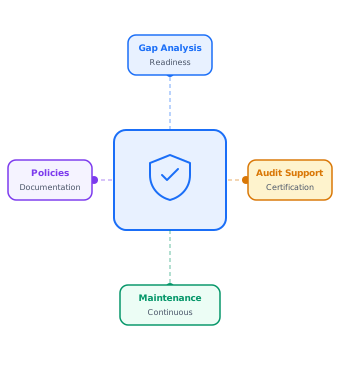
Scope creep is one of the most common reasons SOC 2 programs take longer and cost more than expected. Include too much and you are building controls for systems that do not need them. Define it too narrowly and your auditor flags it. We scope your engagement around your actual product, customer commitments, and data flows, and then assess where your current controls stand against each applicable criterion, so you know exactly what needs to be built before the audit observation period begins.

Security is the only mandatory Trust Services Criterion, but enterprise customers often require Availability, Confidentiality, or Privacy criteria in addition, and your report needs to match what they asked for. We map your existing controls against each applicable criterion, identify what is missing or weak, and tell you exactly what needs to be built or strengthened. No generic frameworks, everything is mapped to your actual environment and the commitments you have made to customers.

Controls that exist only for the audit window, and then get ignored, are the reason so many companies struggle at their Type 2 assessment after sailing through Type 1. We design and implement controls that fit how your team actually works, are sustainable to operate without a dedicated compliance team, and generate the evidence your auditor will look for. The goal is a control environment your engineers and ops team can own, not one that only your security consultant understands.

The most common reason companies extend their Type 2 observation period or receive qualified opinions is not missing controls, it is missing evidence. If your team cannot produce logs, access reviews, vendor assessments, and change records for the full observation window, the controls might as well not exist. We build the policies your auditor requires and set up evidence collection practices from day one of the observation period, so there is nothing to reconstruct when fieldwork starts.

If a customer needs your SOC 2 report in 60 days to close a deal, a Type 1 gets you there faster, it assesses control design at a point in time rather than requiring an observation period. If customers are asking for ongoing operational proof, Type 2 is what they actually want. Giving the wrong type wastes time and may not satisfy the requirement. We assess your timeline, customer requirements, and current readiness to map out the fastest credible path to the report your deals need.

Audit fieldwork generates a constant stream of evidence requests, clarification questions, and follow-ups that can consume your engineering and ops team for weeks. We act as the bridge between your auditor and your team, managing the evidence request queue, answering technical questions, and keeping the engagement moving. If a finding surfaces during fieldwork, we help you respond and remediate without derailing the timeline or your deal.
Understanding SOC 2
What is SOC 2?
SOC 2 is an auditing standard developed by the AICPA that evaluates how a service organization manages customer data. It is built around five Trust Services Criteria: Security (mandatory), Availability, Processing Integrity, Confidentiality, and Privacy. A SOC 2 report, issued by an independent CPA firm, provides customers with formal assurance that your controls are in place and operating effectively.
Who needs it?
SOC 2 is most commonly required of SaaS companies, cloud service providers, data processors, and managed service providers whose customers are enterprises or operate in regulated industries. If your sales process involves security questionnaires, vendor assessments, or procurement requirements from legal or InfoSec teams, SOC 2 is typically what those customers are working toward requiring.
Why does it matter?
Enterprise buyers routinely block or delay vendor onboarding without a current SOC 2 report. Beyond deal velocity, SOC 2 demonstrates that your security program is real, audited by an independent third party, not self-assessed. A qualified or adverse opinion in your report, or a lapse in annual renewal, can be harder to recover from commercially than never having started.
How does it work?
You start with a readiness assessment to understand your gaps, build or strengthen controls, then engage an independent CPA firm for the audit. A Type 1 report evaluates control design at a point in time and can be completed in weeks. A Type 2 report evaluates whether controls operated effectively over 6-12 months, the version most enterprise customers actually require. Annual renewal is expected.
Enterprise prospects kept stalling deals pending our SOC 2. garrisonOne mapped our existing controls to the Trust Services Criteria, identified the gaps, and ran a structured readiness program that got us through Type II in eight months. We closed three deals that had been waiting on the report the week it was issued.
Client results
Technology / SaaS
A seed-stage SaaS startup had customer data in a public S3 bucket. garrisonOne conducted a full AWS security assessment against CIS benchmarks and hardened the environment in 4 weeks.
Financial Services
Manual offboarding across 14 systems took two days. garrisonOne automated the full user lifecycle with HR-driven provisioning and role-based access, cutting offboarding to 10 minutes.
Industry focus
Every business has security weaknesses. The question is whether you find them first — or an attacker does. Penetration testing (also called pen …
Read MoreRelated Services: ISO 27001 Compliance | Security Assessment & Audit | Financial Services Cybersecurity | All Compliance Services
SOC 2 is a framework developed by the AICPA that defines criteria for managing customer data based on five Trust Services Criteria: Security, Availability, Processing Integrity, Confidentiality, and Privacy. It matters because customers, particularly enterprise buyers and regulated industries, increasingly require a SOC 2 report as evidence that you take data security seriously before they will do business with you.
A Type 1 report provides an opinion on whether your controls are suitably designed at a specific point in time. A Type 2 report provides an opinion on whether those controls operated effectively over a defined observation period, typically six to twelve months. Most customers ultimately want a Type 2 report, but a Type 1 can demonstrate initial readiness while the observation period runs.
Security is mandatory for all SOC 2 engagements. The other four criteria, Availability, Processing Integrity, Confidentiality, and Privacy, are added based on your customer commitments and the nature of the services you provide. We help you determine which criteria are relevant to your scope based on your product and the expectations your customers have.
Readiness work before the observation period typically takes one to three months depending on your starting point. The observation period itself is usually six to twelve months. Organizations that are further along in their security maturity can move faster. We assess your current state at the start and give you a realistic timeline based on what we find.
It helps to have an auditor in mind early so you understand their specific expectations and evidence preferences. However, readiness work can begin before you have selected an auditor. We work with any licensed CPA firm and can help you understand what different auditors typically look for during the examination.
Common evidence types include access control logs, change management records, security training completion records, vulnerability scan results, vendor review documentation, incident logs, and configuration screenshots. We help you establish consistent evidence collection practices during the observation period so gathering this is routine rather than a last-minute scramble.
There is significant overlap between SOC 2 Security criteria and ISO 27001 controls. If you are pursuing both, we design your compliance program to address shared requirements once rather than building parallel programs. This reduces overall effort and creates a more coherent governance structure.
SOC 2 establishes a strong baseline of security controls and demonstrates that you take data protection seriously. It is not a guarantee of perfect security. We recommend treating SOC 2 as a foundation and continuing to invest in security beyond the minimum requirements wherever your risk profile warrants it.
Resources
Company
Contact


