14
Systems Under
Automated IAM
Certified Platform Expertise
Map every account, role, and system across your environment
Identify over-privilege, control gaps, and governance failures
Deploy controls, automate lifecycle, vault privileged credentials
Access reviews, ongoing monitoring, and audit evidence generation
Understanding IAM
What is IAM?
Identity and Access Management is the framework of policies, processes, and technologies that control who can access which systems, data, and resources, and under what conditions. A complete IAM program covers user lifecycle management, authentication, authorization, privileged access, and identity governance across cloud, on-premise, and SaaS environments.
Who needs it?
Every organization with remote workers, cloud infrastructure, SaaS sprawl, or privileged administrator accounts needs IAM. It becomes non-negotiable when HIPAA, SOC 2, ISO 27001, or PCI DSS require demonstrable control over who can access sensitive data, and when cyber insurance underwriters ask the same question during policy renewal.
Why does it matter?
Over 80% of breaches involve compromised credentials or excessive access. Former employees with active accounts, admins using shared passwords, and users with far more access than their role requires are among the most commonly exploited conditions in any environment. IAM directly limits the blast radius of a credential compromise, and is the first control auditors and cyber insurers evaluate.
How does an IAM program work?
A mature IAM program starts with identity governance, knowing who has access to what, then enforces least privilege through RBAC, automates the user lifecycle so access is granted and revoked accurately, protects privileged accounts through PAM, and strengthens authentication through MFA and SSO. Periodic access reviews catch what automated controls miss.
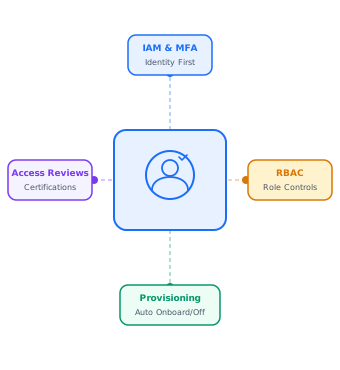
Every time someone left the company, we manually had to track down their access across 14 different systems. garrisonOne implemented a full IAM framework with automated provisioning, role-based access tied to HR data, and MFA across every application. Offboarding that used to take two days now takes ten minutes.
Client results
Financial Services
Manual offboarding across 14 systems took two days. garrisonOne automated the full user lifecycle with HR-driven provisioning and role-based access, cutting offboarding to 10 minutes.
Healthcare
200+ orphaned accounts remediated, zero audit findings after rollout, and full privileged access brought under governance across a multi-site medical practice.
Industry focus

Penetration testing prices vary enormously, from a few thousand pounds for a focused web application test to well over £50,000 for a full red …
Read More
Both penetration testing and vulnerability assessments are designed to find weaknesses in your systems. But they work very differently, and confusing …
Read More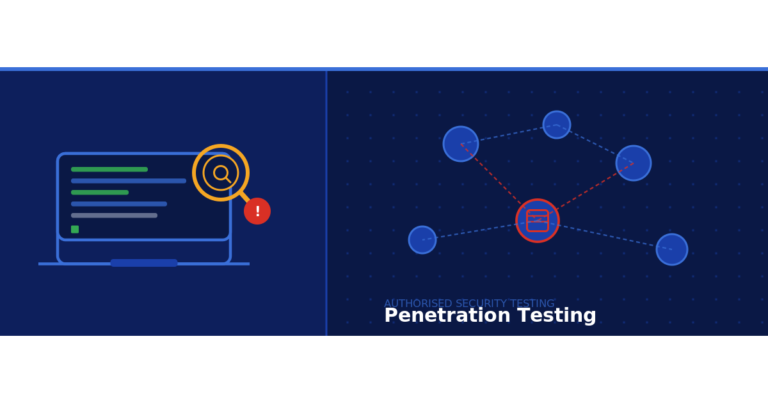
Every business has security weaknesses. The question is whether you find them first, or an attacker does. Penetration testing (also called pen …
Read MoreProfessional Services: Automated provisioning, MFA, and role-based access across 14 systems
Read Case StudyRetail: Unified identity for 340 staff, onboarding time cut by 70 percent
Read Case StudyIAM is the discipline of ensuring the right people have the right level of access to the right resources and that access is removed when it is no longer needed. It spans authentication, authorisation, provisioning, and ongoing governance.
IAM directly reduces the attack surface by enforcing least privilege access, eliminating dormant accounts, and giving you full visibility into who can access what. Most data breaches involve compromised credentials, and strong IAM controls make those credentials far harder to exploit.
SSO lets users authenticate once and access all their authorised applications without logging in separately to each one. It improves user experience, reduces password fatigue, and when combined with MFA significantly strengthens security.
MFA requires users to verify their identity with at least two factors, typically a password plus a one time code, push notification, or biometric. It is one of the most effective controls against account takeover, even when passwords are compromised.
RBAC assigns access permissions based on a user's job role rather than individually. When someone changes roles or leaves, access adjusts automatically. It simplifies administration and makes it much easier to enforce least privilege at scale.
Access reviews are structured checks to confirm that users still need and are still entitled to their current access. We recommend quarterly reviews for sensitive systems and annual reviews for standard access, with automated tooling to flag anomalies between cycles.
No. IAM scales to organisations of any size. Even a company of 20 people benefits from SSO, MFA, and a clear offboarding process. The tools and approach are sized to fit your organisation.
PAM focuses on securing accounts with elevated permissions such as administrators, database owners, service accounts, and other users whose access could cause significant damage if compromised. It provides controls that go beyond standard IAM.
Privileged accounts can modify systems, access sensitive data, and disable security controls. Attackers who gain control of a privileged account can move freely across your environment with minimal friction, making them the most valuable credential to compromise.
PAM covers administrator accounts, root accounts, service accounts, application accounts with elevated permissions, shared credentials, and emergency break glass accounts used for crisis situations.
Core PAM controls include password vaulting which stores credentials securely and rotates them automatically, session recording, just in time access that grants elevated permissions only for the duration of a specific task, and approval based workflows for sensitive actions.
Modern PAM solutions are designed to minimise friction for legitimate users while adding meaningful barriers for attackers. In practice, most administrators find that structured access workflows and reduced credential sprawl make their work cleaner rather than harder.
Yes. PAM and IAM are complementary. IAM governs standard user access while PAM adds a specialist control layer for high risk accounts. We implement PAM solutions that integrate with SailPoint, Okta, Entra ID, and other platforms you may already use.
Yes. Any organisation with critical systems, cloud infrastructure, or admin accounts needs some form of privileged access control. We size and scope PAM implementations to match your environment and risk level.
Vault credentials, record sessions, and enforce just-in-time access for every privileged account.
Unify authentication across your application stack with SAML 2.0 and OIDC.
Deploy MFA across every access point including phishing-resistant FIDO2 for privileged users.
Move from implicit network trust to identity-first, least-privilege access architecture.
Design and implement least-privilege access models with SoD controls and access certification.
Deploy and configure Okta Workforce Identity for SSO, MFA, lifecycle management, and governance.
Harden Azure AD, configure conditional access, PIM, and hybrid identity for Microsoft environments.
Implement SailPoint IdentityIQ or IdentityNow for enterprise identity governance and access certification.
Cloud-native identity management for AWS, Azure, GCP, and multi-cloud environments.
Integrate identity management platforms with your existing technology stack.
Resources
Company
Contact


