SOC 2
Type II Achieved
Under vCISO

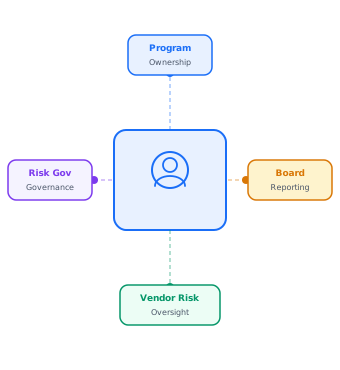
We take ownership of your information security program and provide the strategic direction needed to build it into a mature, functioning capability. This includes defining program structure, setting priorities, aligning security investment with business risk, and driving execution across your technical and operational teams. The vCISO acts as an accountable security leader, not just an advisor providing recommendations your internal team must implement without guidance.

We establish and operate a risk management process that identifies your most significant security risks, evaluates them in business terms, and produces a risk register that leadership can use to make informed decisions. We also design the governance structures your security program needs, including security committee participation, policy ownership, escalation paths, and management review processes that keep leadership informed and accountable.

Many organizations pursuing ISO 27001, SOC 2, HIPAA, or PCI DSS need a security leader to own the compliance program, not just consultants to deliver point-in-time work. Our vCISO provides continuous compliance program oversight, ensuring that controls are implemented and maintained, that documentation stays current, and that your organization is always in a state of audit readiness rather than scrambling in the weeks before an assessment.

Boards and executive teams need security information presented in terms of business risk, not technical metrics. We develop and deliver security reporting that gives your leadership team a clear picture of your security posture, the risks that require their attention, and how your program is performing over time. We also support direct board engagement when security topics require executive-level discussion, acting as the credible security voice your leadership needs.

When a security incident occurs, your organization needs a leader who can assess the situation, make rapid decisions, coordinate the response, and communicate clearly with internal stakeholders, customers, and regulators. We provide incident response leadership as part of the vCISO engagement, ensuring that when an incident happens you have an experienced security executive directing the response rather than improvising under pressure.

Third-party risk is one of the leading sources of security incidents for organizations of all sizes. We manage your vendor security program as part of the vCISO engagement, including security assessment of new vendors, ongoing monitoring of critical suppliers, Business Associate Agreement management for HIPAA-covered organizations, and escalation of third-party risks that require leadership attention or contractual remediation.
We were growing fast and knew we needed real security leadership, but a full-time CISO was out of reach financially. garrisonOne's vCISO stepped in immediately: built our security program, handled our SOC 2 preparation, and presents to our board quarterly. It's everything we needed at a fraction of the cost.
Client results
Legal
A 90-day remediation roadmap delivered after a full security assessment. The firm met enterprise client security requirements and avoided a regulatory incident.
Technology / SaaS
A seed-stage SaaS startup had customer data in a public S3 bucket. garrisonOne conducted a full AWS security assessment against CIS benchmarks and hardened the environment in 4 weeks.
Industry focus

Penetration testing prices vary enormously, from a few thousand pounds for a focused web application test to well over £50,000 for a full red …
Read More
Both penetration testing and vulnerability assessments are designed to find weaknesses in your systems. But they work very differently, and confusing …
Read More
Every business has security weaknesses. The question is whether you find them first, or an attacker does. Penetration testing (also called pen …
Read MoreRelated Services: IT Strategy Planning | Compliance & Certifications | Security Risk Management | All Cybersecurity Services
A virtual CISO, or vCISO, is an experienced security executive who provides Chief Information Security Officer-level leadership to an organization on a part-time or fractional basis. The vCISO owns your security program, leads risk and compliance efforts, reports to leadership on security posture, and acts as an accountable security decision-maker, without the overhead and fixed cost of a full-time executive hire. Organizations typically engage a vCISO when they need genuine security leadership but are not yet at the scale that justifies a permanent CISO role.
A security consultant typically delivers a specific project or assessment and then moves on. A vCISO provides ongoing leadership, owns program decisions, and maintains continuity across your security and compliance efforts over time. The vCISO relationship builds institutional knowledge about your organization that a series of project-based consultants never accumulates. The accountability model is different as well. A consultant provides recommendations; a vCISO owns outcomes.
Organizations that benefit most include fast-growing technology companies that need a security program before they can justify a full-time CISO, mid-size organizations in regulated industries that need compliance program leadership, businesses pursuing enterprise clients that require evidence of mature security governance, and organizations that have experienced a security incident and need to build a proper program under credible leadership. The common thread is the need for real security leadership at a cost structure that matches the organization's stage.
Engagement intensity varies based on where your organization is in its security maturity and what you are trying to accomplish. Organizations building a security program from scratch or managing an active compliance certification typically need more intensive support in the range of eight to twelve days per month. Organizations with a more established program that need ongoing oversight and leadership may need four to six days per month. We define engagement scope based on your specific situation rather than applying a standard model.
Yes. Compliance program management is one of the core functions of the vCISO engagement. This includes owning the compliance roadmap, managing the implementation of required controls, maintaining documentation and evidence, and leading the organization through certification audits. Having a dedicated security leader own the compliance program produces far better outcomes than managing it through a combination of internal staff and point-in-time consultants who do not have ongoing accountability for the result.
The vCISO leads your incident response. This means assessing the situation, directing your technical team's response actions, managing communication to leadership and affected parties, coordinating with legal and external advisors where needed, and ensuring that post-incident reviews and regulatory notifications are handled correctly and on time. Having an experienced security executive available during an incident significantly improves both the quality of the response and the speed at which it resolves.
We develop a reporting cadence and format tailored to your board's and leadership team's needs. Typically this includes a quarterly security update covering risk posture, compliance status, significant incidents, and program progress, along with a dashboard or scorecard that gives leadership an ongoing view of key security metrics. We present directly to boards and executive committees and are accustomed to fielding questions from non-technical audiences about security risk and investment.
When your organization is ready to hire a permanent CISO, we support the transition actively. We help define the role and required qualifications based on what your program needs, contribute context to the search and interview process, and ensure that the program documentation, risk register, compliance artifacts, and institutional knowledge we have developed transfer cleanly to your incoming CISO. The goal is continuity of program quality, not dependency on our continued involvement.
Resources
Company
Contact


