 by
When you start the SOC 2 process, the first question most organisations face is whether to pursue a Type I or Type II report. The answer depends on where you are in your business, who’s asking for it, and how quickly you need it.
This guide cuts through the noise with a practical answer, not just the technical differences, but the real-world factors that determine which one is right for your situation.
The core difference
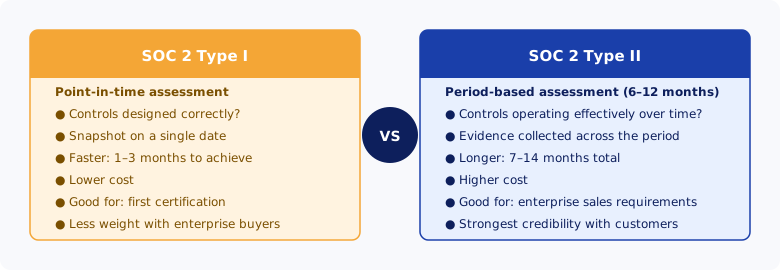
Both reports are produced by an independent auditor. The difference is what the auditor is looking for:
- SOC 2 Type I answers: “Are your security controls designed correctly?” It’s assessed at a single point in time, like a photograph of your controls on the day the auditor visits.
- SOC 2 Type II answers: “Have your security controls been operating effectively over time?” The auditor reviews evidence collected across a 6–12 month observation period, like a film rather than a photograph.
Side-by-side comparison
| Factor | SOC 2 Type I | SOC 2 Type II |
|---|---|---|
| What it assesses | Control design at a point in time | Control operation over 6–12 months |
| Typical time to achieve | 2–5 months | 7–14 months |
| Typical cost | $10,000 – $30,000 | $20,000 – $60,000+ |
| Evidence period | None, point-in-time | 6–12 months |
| Enterprise buyer acceptance | Sometimes accepted | Usually required |
| PCI DSS / HIPAA alignment | Partial | Strong |
| Best for | First report, early-stage company | Enterprise sales, compliance mandates |
When Type I makes sense
Type I is the right choice when:
- You need something quickly, a prospect is asking for a SOC 2 report before the contract signs, and you don’t have 12 months to wait
- You’re starting from scratch, getting a Type I first lets you identify and fix control gaps before the longer Type II observation period begins
- Your customers are early-stage buyers, some SME customers accept Type I as sufficient assurance
- Budget is constrained, Type I costs roughly half as much as Type II and can be used as a stepping stone
When Type II is the right choice
Type II is what you need when:
- Your target customers are enterprises, Fortune 500 companies, financial institutions, and healthcare organisations almost universally require Type II
- You’re responding to RFPs, most formal procurement processes specify Type II in their vendor security questionnaires
- You need compliance alignment, PCI DSS Level 1 merchants, HIPAA Business Associates, and government contractors typically need evidence of operating effectiveness over time, which only Type II provides
- You’re preparing for acquisition, due diligence processes expect Type II; a Type I may trigger further scrutiny
Can you do Type I first, then Type II?
Yes, and this is the most common path for companies starting the SOC 2 journey. The typical sequence:
- Month 1–2: Readiness assessment, identify gaps and fix control weaknesses
- Month 3–4: Type I audit, get a report you can share with prospects now
- Month 5 onwards: Start the Type II observation period, collect evidence as your controls operate
- Month 11–14: Type II audit and report issued
This approach gives you something to show customers quickly while building toward the report that enterprise buyers actually require. The Type I work isn’t wasted, it feeds directly into the Type II process.
What your customers are actually asking for
If a customer or prospect has asked you for a “SOC 2 report” without specifying Type I or II, it’s worth asking them directly which they need. In our experience:
- SME buyers often don’t distinguish between the types and will accept either
- Mid-market buyers often prefer Type II but may accept Type I with a commitment to upgrade
- Enterprise procurement teams almost always specify Type II, and their security questionnaires often ask for the audit period dates to verify it
Frequently asked questions
Does a SOC 2 Type I expire?
SOC 2 reports don’t technically expire, but they become less meaningful over time. Most enterprise buyers expect a report dated within the last 12 months. A Type I from two years ago is unlikely to satisfy a procurement team today.
Can you skip Type I and go straight to Type II?
Yes. If you have the time and budget, going straight to Type II avoids the cost of doing two audits. The downside is that you have nothing to show customers for the 7–14 months it takes. Many organisations do Type I first precisely to have something to share during the Type II observation period.
Is SOC 2 Type II the same as certified?
The word “certified” is technically incorrect for SOC 2, the auditor issues a “report with an opinion,” not a certificate. But in common usage, having a Type II report is what people mean when they say “SOC 2 certified.”
Not sure which SOC 2 report you need?
garrisonOne’s compliance team can review your customer requirements and compliance obligations and recommend the right path, so you’re not spending more than you need or falling short of what buyers require.
Talk to our SOC 2 team →Related reading: Start with What Is SOC 2 Compliance? Everything You Need to Know, or jump to How Long Does SOC 2 Certification Take? for timeline planning.
Frequently Asked Questions
Do enterprise customers accept SOC 2 Type I?
Most enterprise buyers and procurement teams require SOC 2 Type II specifically, since Type I only confirms controls are designed correctly, not that they actually operated effectively over time.
Can I start with Type I and upgrade to Type II later?
Yes, this is a common and recommended path. A Type I report demonstrates early compliance momentum to customers while you accumulate the observation period needed for a Type II report.
How much more does Type II cost compared to Type I?
Type II engagements typically cost more than Type I due to the extended audit period and additional evidence review, though the exact difference depends on your auditor and the complexity of your environment.


