<1h
Compromise to
Financial DB

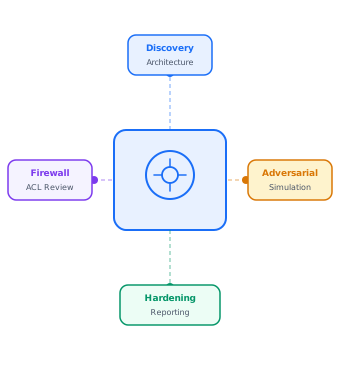
From a foothold inside your network, we enumerate hosts, services, shares, users, groups, and network topology using the same passive and active techniques a real attacker would use. This phase identifies targets of value and maps the internal attack surface before exploitation begins.

Active Directory is the target in the overwhelming majority of enterprise breaches. We test for Kerberoasting, AS-REP roasting, Pass-the-Hash, Pass-the-Ticket, DCSync, Golden Ticket, Silver Ticket, ACL abuse, delegation misconfigurations, and GPO-based privilege escalation paths from standard user to domain administrator.

Using compromised credentials and discovered vulnerabilities, we move laterally through your network to simulate what a real attacker would do after gaining initial access. We identify flat network segments, over-permissive firewall rules, and SMB signing weaknesses that enable credential relay attacks.

We test for local privilege escalation from standard user to local administrator using unquoted service paths, weak registry permissions, scheduled task abuse, and known local privilege escalation vulnerabilities. We also test for domain privilege escalation through AD misconfigurations and LAPS weaknesses.

We identify sensitive data exposed on file shares, identify password files and credential caches, and test for cleartext credentials in scripts, configuration files, and Group Policy preferences. Access to this data is documented and its business impact assessed.

We provide a visual attack path diagram showing the full compromise chain from initial access to domain admin or critical data. Every step in the path is documented with the specific misconfiguration or vulnerability that enabled it, and remediation guidance is prioritized by impact on breaking the attack chain.
We had invested in a next-gen firewall and EDR platform and felt reasonably secure. garrisonOne's internal test showed that from a single compromised user account, they could reach our SQL server containing customer financial data in under an hour using only built-in Windows tools: nothing that would trigger our EDR. The segmentation work that followed was long overdue.
Client results
Retail
Pre-PCI DSS audit penetration test uncovered critical vulnerabilities in the payment processing environment. All findings remediated before the QSA assessment.
Manufacturing
Full network penetration test and security assessment for a regional distributor ahead of cyber insurance renewal. Coverage secured at preferred rates.
Industry focus

Penetration testing prices vary enormously, from a few thousand pounds for a focused web application test to well over £50,000 for a full red …
Read More
Both penetration testing and vulnerability assessments are designed to find weaknesses in your systems. But they work very differently, and confusing …
Read More
Every business has security weaknesses. The question is whether you find them first, or an attacker does. Penetration testing (also called pen …
Read MoreRelated Services: Penetration Testing | Network Penetration Testing | External Penetration Testing | Red Team Services
Internal network penetration testing simulates a threat actor operating inside your network: after bypassing perimeter controls through a phishing attack, compromised credentials, physical access, or insider threat. The test maps lateral movement paths, privilege escalation routes, and access to critical systems from a compromised starting position.
We typically start from a standard unprivileged user account: representing a compromised employee credential: and a standard workstation access. This is the most realistic starting point for most organizations. We can also test from other starting positions such as a guest network segment or a compromised contractor account.
We test for Kerberoasting (cracking service account passwords from TGS tickets), AS-REP roasting (accounts with preauthentication disabled), Pass-the-Hash, Pass-the-Ticket, DCSync (extracting credential hashes), Golden and Silver Ticket attacks, ACL-based privilege escalation, delegation abuse (unconstrained, constrained, and resource-based), and GPO misconfiguration.
An internal network test typically takes two to three weeks depending on network size and complexity. Larger environments with multiple domain trusts may require three to four weeks for complete coverage.
Yes. Ransomware operators follow predictable attack chains: initial compromise, lateral movement, domain admin acquisition, defense evasion, and deployment. We specifically map the paths that ransomware operators would take in your environment and identify where those paths can be broken.
A vulnerability scan uses automated tools to identify known vulnerabilities on accessible systems. An internal penetration test uses those findings as a starting point and adds manual exploitation, Active Directory attack testing, lateral movement simulation, and privilege escalation chains. The penetration test shows what an attacker would actually do with discovered vulnerabilities, not just that they exist.
We establish a clear rules of engagement document before testing begins that defines the scope, starting position, out-of-scope systems, testing hours, and emergency contact procedures. We maintain communication with your IT team throughout and immediately report any critical finding that poses an immediate risk to your environment.
Yes. Testing whether critical systems are properly isolated from general user networks is a key objective of internal testing. We atte