3
Hops to Domain
Admin Found

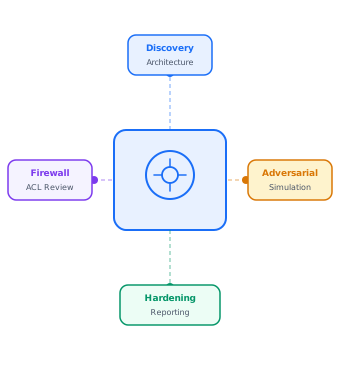
Before testing begins we map your attack surface the way real attackers do: DNS enumeration, certificate transparency analysis, exposed service discovery, and OSINT collection to build a complete picture of what is visible to an external attacker. This phase often reveals forgotten systems and services that internal teams have lost track of.

We probe your internet-facing infrastructure for exploitable vulnerabilities in firewalls, VPNs, remote access solutions, public-facing servers, and cloud-connected endpoints. External testing simulates what an attacker on the open internet can find and exploit with no prior access to your environment.

Simulating a threat actor who has bypassed perimeter controls: whether through a phishing attack, compromised credentials, or physical access: our internal testing probes for flat network architecture, over-privileged service accounts, unpatched systems, and misconfigured network devices that allow lateral movement to critical systems.

Once initial access is established, we simulate what a real attacker would do with it. We probe for lateral movement paths, privilege escalation vectors, credential reuse opportunities, and routes to your most sensitive systems: showing you exactly how far a breach could realistically go.

Active Directory is the target in the overwhelming majority of enterprise breaches. We test for Kerberoasting, AS-REP roasting, Pass-the-Hash, DCSync attacks, delegation abuse, and misconfigured group policies that would allow an attacker to escalate from a standard user to domain administrator.

Every finding is documented with network path evidence, a proof-of-concept demonstrating exploitability, the business risk represented by the finding, and specific remediation guidance. We include a prioritized remediation roadmap that distinguishes between immediate critical fixes and longer-term architectural improvements.
garrisonOne's internal network test revealed that a standard user account could reach our domain controller in three hops due to a misconfigured service account. They showed us the entire attack chain: from initial access to domain admin: in a way that finally made our leadership understand why we needed to invest in network segmentation. Budget approved the same week.
Client results
Manufacturing
Full network penetration test and security assessment for a regional distributor ahead of cyber insurance renewal. Coverage secured at preferred rates.
Industry focus

Penetration testing prices vary enormously, from a few thousand pounds for a focused web application test to well over £50,000 for a full red …
Read More
Both penetration testing and vulnerability assessments are designed to find weaknesses in your systems. But they work very differently, and confusing …
Read More
Every business has security weaknesses. The question is whether you find them first, or an attacker does. Penetration testing (also called pen …
Read MoreRelated Services: Penetration Testing | Internal Network Testing | External Penetration Testing | Network Security Services
External network penetration testing simulates an attacker on the open internet: probing your internet-facing systems, services, and remote access solutions for exploitable vulnerabilities. Internal network penetration testing simulates an attacker who has already breached your perimeter: through a phishing attack, compromised credentials, or rogue device: and is probing your internal infrastructure for lateral movement paths and critical system access. Most organizations benefit from both.
We design network penetration tests to avoid service disruption. Any potentially disruptive test: such as exploitation attempts against production systems: is coordinated with your team in advance. Testing is typically conducted in a controlled manner that is invisible to users during business hours.
Active Directory testing involves probing for misconfigurations and known attack techniques including Kerberoasting, AS-REP roasting, Pass-the-Hash, Pass-the-Ticket, DCSync, delegation abuse, and misconfigured group policies. AD is the target in the majority of enterprise breaches, so thorough AD testing is a critical component of any internal network engagement.
An external-only engagement typically takes one to two weeks. A full internal and external assessment may take two to four weeks depending on network size and complexity. We provide a clear timeline during scoping.
Yes. We include testing of VPN gateways, cloud-connected endpoints, and hybrid network architectures. For dedicated cloud security testing of AWS, Azure, or GCP environments, we recommend combining network testing with our cloud penetration testing service.
The most common critical findings include unpatched systems with known exploits, misconfigured Active Directory with privilege escalation paths, flat network architecture allowing unrestricted lateral movement, exposed management interfaces (RDP, SSH, WinRM) accessible from the internet, weak credentials on service accounts, and VPN configurations with outdated protocols.
PCI DSS requires network penetration testing at least annually and after significant changes. HIPAA does not mandate penetration testing explicitly but requires regular risk assessments which most auditors expect to include penetration testing. SOC 2, ISO 27001, and CMMC all include requirements that are typically satisfied through regular network penetration testing.
Yes, retesting is included. After your team has addressed findings, we verify that the fixes are effective and that no new vulnerabilities were introduced during the remediation process.
Resources
Company
Contact


