1
Privilege Escalation
Path to Admin

Over-permissive IAM roles and policies are the most commonly exploited attack vector in cloud breaches. We enumerate every role, policy, and permission boundary in your environment to identify paths from a low-privilege identity to administrative access: including cross-account escalation paths that span multiple AWS accounts or Azure subscriptions.

Publicly accessible S3 buckets, Azure Blob containers, and GCP Cloud Storage buckets have been responsible for some of the largest data breaches in history. We enumerate all storage resources and test for public access, over-permissive bucket policies, and sensitive data that should not be accessible from outside your environment.

We audit security groups, network ACLs, VPC configurations, and firewall rules for misconfigurations that expose management interfaces, internal services, or sensitive databases to the internet. We also test for SSRF vulnerabilities that could allow an attacker to access the instance metadata service and retrieve credentials.

Lambda functions, Azure Functions, and GCP Cloud Functions often have excessive permissions and insufficient input validation. We test serverless functions for injection vulnerabilities, event injection, insecure direct object reference, and IAM permission abuse. Container environments are tested for image vulnerabilities, misconfigured registries, and container escape paths.

We enumerate your cloud attack surface from an external perspective: discovering publicly exposed resources, misconfigured DNS records, exposed APIs, and unauthenticated services. We also test from an authenticated low-privilege perspective to simulate what an attacker with stolen credentials could access.

Findings are documented with evidence screenshots, exploitation steps, the business risk represented, and specific remediation guidance. Reports are structured to support cloud security frameworks including CIS AWS Foundations Benchmark, Azure Security Benchmark, and GCP CIS Benchmark.
We thought our AWS environment was secure because we had been following the setup guides. garrisonOne found that one of our developer IAM roles had a privilege escalation path to AdministratorAccess through a misconfigured Lambda execution role. They mapped the entire attack chain in a diagram our board could understand. Remediation took one afternoon.
Client results
Technology / SaaS
A seed-stage SaaS startup had customer data in a public S3 bucket. garrisonOne conducted a full AWS security assessment against CIS benchmarks and hardened the environment in 4 weeks.
Industry focus

Penetration testing prices vary enormously, from a few thousand pounds for a focused web application test to well over £50,000 for a full red …
Read More
Both penetration testing and vulnerability assessments are designed to find weaknesses in your systems. But they work very differently, and confusing …
Read More
Every business has security weaknesses. The question is whether you find them first, or an attacker does. Penetration testing (also called pen …
Read MoreRelated Services: Penetration Testing | Cloud Security Services | Web App Penetration Testing | API Security Testing
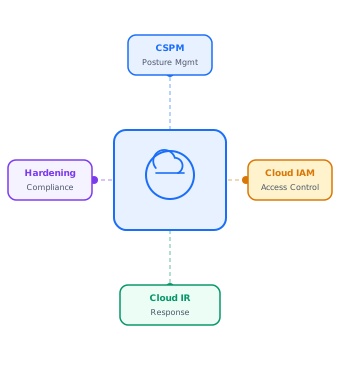
Cloud penetration testing covers IAM configuration and privilege escalation paths, storage and data exposure, network security group and firewall misconfiguration, serverless function security, container security, metadata service exploitation, cross-account trust abuse, and externally exposed services. The specific coverage depends on which cloud platforms and services you use.
A cloud security assessment is primarily a configuration review: checking your environment against best practices and benchmarks like the CIS AWS Foundations Benchmark. Cloud penetration testing is adversarial: we attempt to actively exploit misconfigured IAM roles, storage permissions, and network controls to demonstrate the real impact of findings. We recommend combining both approaches for comprehensive coverage.
For an authenticated cloud penetration test, yes: we typically need credentials representing a low-privilege user or role to simulate what an attacker with stolen credentials could access. For external testing, we can begin without credentials to simulate an unauthenticated attacker. The most thorough assessments combine both.
We work with your team to scope testing appropriately and avoid production disruption. Destructive tests: such as deleting resources: are never performed without explicit authorization. We test read access, privilege escalation paths, and configuration issues rather than causing service disruption.
The most common critical findings are: over-privileged IAM roles with wildcard permissions, publicly accessible S3 buckets or storage containers containing sensitive data, instance metadata service (IMDS) accessible without IMDSv2 enforcement, security groups allowing unrestricted inbound access to management ports, and Lambda or Cloud Function IAM roles with excessive permissions enabling lateral movement.
Yes. Kubernetes and container security is included in cloud penetration testing engagements. We test for misconfigured RBAC, exposed API servers, insecure pod security policies, container escape paths, and image pull secret exposure.
PCI DSS requires penetration testing of all in-scope systems including cloud environments. SOC 2 and ISO 27001 include requirements that typically require cloud security testing. FedRAMP requires cloud security assessment and penetration testing for government-connected cloud environments.
A focused cloud penetration test of a single AWS account or Azure subscription typically takes one to two weeks. Multi-account or multi-cloud environments may require two to four weeks. We provide a timeline after reviewing your cloud architecture.
Resources
Company
Contact


