1
Chained Attack
Path Found

We test against the full OWASP Top 10: injection, broken authentication, sensitive data exposure, XML external entities, broken access control, security misconfiguration, XSS, insecure deserialization, known vulnerabilities, and insufficient logging. But we do not stop there. OWASP is a floor, not a ceiling.

Weak authentication and session handling are among the most exploited web vulnerabilities. We test password policies, MFA bypass paths, session fixation, token predictability, concurrent session issues, and logout behavior to find every path an attacker could use to impersonate a legitimate user.

Business logic vulnerabilities cannot be detected by scanners because they require understanding how your application is supposed to work. We test price manipulation, workflow bypass, privilege escalation through application features, and any logic flaw an attacker could exploit to gain an advantage they are not entitled to.

Modern web applications depend heavily on APIs that often have weaker security controls than the user interface. We test REST and GraphQL APIs against the OWASP API Top 10: broken object authorization, broken authentication, excessive data exposure, lack of rate limiting, and injection flaws at the API layer.

We probe every input for SQL injection, command injection, XXE, SSTI, and path traversal. On the client side, we test for XSS, CSRF, clickjacking, open redirects, and content security policy weaknesses that could allow attackers to compromise users of your application rather than the server itself.

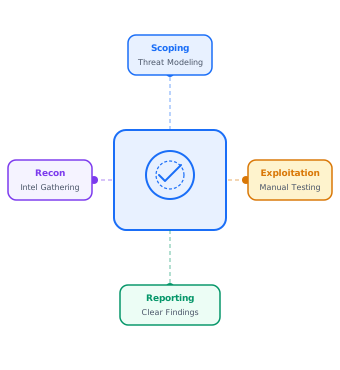
Every vulnerability is documented with a proof-of-concept demonstration, a business impact statement, and specific remediation guidance. We provide both a technical report for your development team and an executive summary for leadership, and walk your team through each finding in a debrief session.
Our development team thought they had covered all the OWASP basics. garrisonOne found a chained attack combining an IDOR flaw and a session token weakness that would have let any authenticated user access any other account. Scanner would never have found that. We fixed everything before our enterprise launch and the security review from our first big customer passed without a single finding.
Client results
Retail
Pre-PCI DSS audit penetration test uncovered critical vulnerabilities in the payment processing environment. All findings remediated before the QSA assessment.
Industry focus

Penetration testing prices vary enormously, from a few thousand pounds for a focused web application test to well over £50,000 for a full red …
Read More
Both penetration testing and vulnerability assessments are designed to find weaknesses in your systems. But they work very differently, and confusing …
Read More
Every business has security weaknesses. The question is whether you find them first, or an attacker does. Penetration testing (also called pen …
Read MoreRelated Services: Penetration Testing | API Security Testing | Network Penetration Testing | Vulnerability Assessment
Retail: 23 vulnerabilities found, PCI DSS scope covered, full remediation in 6 weeks
Read Case StudyWeb application penetration testing covers authentication and session management, access control, input validation and injection attacks, business logic flaws, API security, client-side vulnerabilities, and sensitive data exposure. A well-scoped engagement tests the full OWASP Top 10 and goes beyond it to find logic-level vulnerabilities that automated tools cannot detect.
Automated scanners recognize known vulnerability patterns and are fast at surface-level discovery. Manual testing is required to find business logic flaws, authentication bypasses, chained vulnerabilities, and any issue that requires understanding how your application is supposed to work. Most critical vulnerabilities found in penetration tests are discovered manually, not by automated tools.
A focused test on a single web application typically takes one to two weeks. More complex applications with extensive APIs or multiple user roles may require two to four weeks. We provide a clear timeline during scoping based on the size and complexity of your application.
Yes. We test REST and GraphQL APIs as a standard part of any web application engagement. API security testing is guided by the OWASP API Security Top 10 and includes broken object-level authorization, broken authentication, excessive data exposure, rate limiting, and injection flaws specific to the API layer.
We design all testing to be non-destructive and coordinate with your team around production windows. Any test with potential for service impact is discussed and scheduled in advance. Most testing is conducted in a way that is invisible to end users.
The report includes an executive summary, a full findings section with each vulnerability described, a proof-of-concept demonstration, a CVSS risk rating, the business impact, and specific remediation steps. A separate technical appendix provides raw tool output for your development team.
Yes. Retesting is included in our web application penetration testing engagements. After your team has remediated the findings, we retest every issue to confirm the fix is effective and that no new vulnerabilities were introduced.
At minimum, annually or after any significant release or infrastructure change. Organizations processing payment card data under PCI DSS are required to test annually and after major changes. SaaS companies targeting enterprise buyers often run tests before major sales cycles or SOC 2 audits.
Resources
Company
Contact


